Raised vs Floor Feeding for Chihuahuas: Does It Matter?
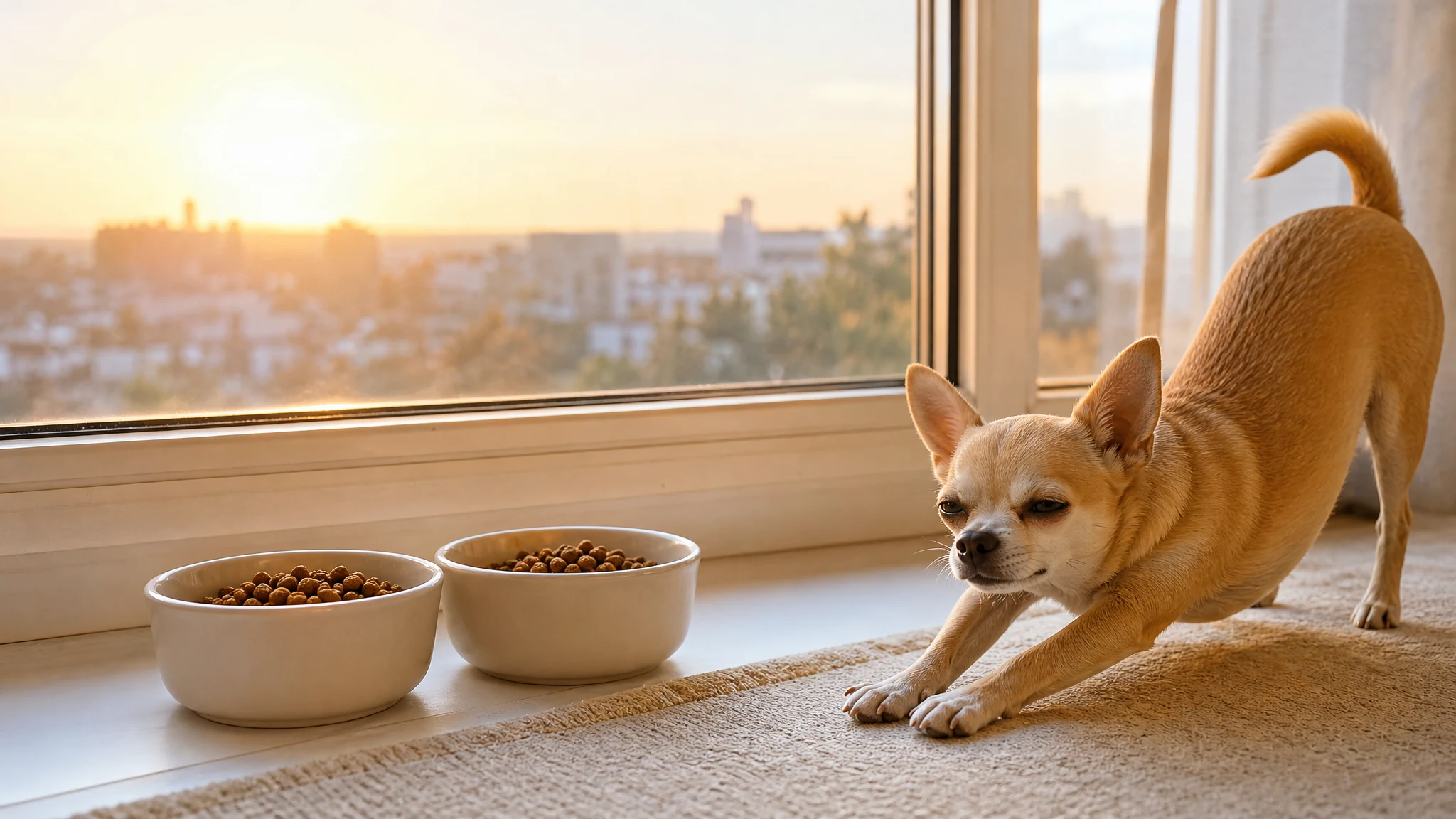
General nutrition information compiled from product labels and published sources, not veterinary advice. Your veterinarian is the right person to choose a diet for your dog, especially one with a health condition.
Most Chihuahua owners eventually wonder if the bowl belongs on the floor or up on a stand. The honest answer is that for most small, healthy dogs, the food and the portion matter far more than the height of the bowl.
Still, the setup can make mealtimes easier. This guide shows you how to build a simple dog feeding station, how to decide between raised and floor feeding, and how to avoid common mistakes. It is a practical how-to, not a medical guide.
What we can and cannot say about bowl height
We looked for solid breed-specific evidence that a raised bowl improves health or digestion in Chihuahuas. We did not find any in the sources we relied on. We also have not fed dogs or run any trials ourselves.
So treat bowl height as a comfort and convenience choice. Do not treat it as a way to prevent or treat any condition. If your dog coughs, gags, vomits, or struggles to swallow at meals, that is a question for your veterinarian, not a reason to buy new equipment.
Why a Chihuahua's size shapes the choice
Chihuahuas are tiny. Hill's Pet Nutrition lists the breed at about 2 to 6 pounds and says they seldom exceed six pounds. Wikipedia notes that pet Chihuahuas often go above the show standard, and some pass 9 pounds. Either way, this is a toy dog with a short reach.
That size creates two practical issues:
- A standard raised feeder made for a medium dog may sit far too high for a Chihuahua.
- A deep bowl on the floor can make a pointed muzzle work harder to reach the last bites.
Royal Canin describes its Chihuahua kibble as small-sized, designed for the breed's pointed muzzle and tiny jaw. That points to the same idea: fit the setup to a small face.
Raised vs floor feeding at a glance
| Point | Floor feeding | Slightly raised feeding |
|---|---|---|
| Cost | Usually the cheapest option | Needs a small stand or a low platform |
| Fit for a toy dog | Works well with a shallow bowl | Only works if the height is very low |
| Cleanup | Crumbs and splashes land on the floor | A tray or mat still helps |
| Stability | Bowls can slide without a mat | Stands can tip if they are top-heavy |
| Evidence of health benefit | None claimed | None found in our sources |
If your Chihuahua eats comfortably from the floor, you have no need to change anything. A raised option can be a convenience, for example for an older dog who seems more comfortable with a slightly higher bowl. Your vet can tell you if that applies.
Materials you need
You do not need much. Here is a basic list for a small dog feeding station:
- A shallow, wide bowl in stainless steel or ceramic, sized for a toy dog
- A separate small water bowl
- A non-slip mat or tray to catch spills
- A measuring cup, or a kitchen scale if your food label lists grams
- A very low stand or sturdy platform, only if you want to try raised feeding
- The feeding guide from your dog's food label
- A notebook or phone note to track portions and your dog's weight
Step-by-step: build your Chihuahua's feeding station
Step 1: Pick a quiet, stable spot
Choose a corner away from foot traffic, doors and loud appliances. Small dogs can be startled easily, and a calm spot helps them settle. Hard floors are easy to clean, but they are slippery, so plan to use a mat.
Step 2: Watch how your dog eats now
Before changing anything, watch a few meals. Notice these things:
- Does your dog stretch awkwardly or tip the bowl to reach food?
- Does your dog push the bowl across the floor?
- Does your dog gulp quickly, cough, or gag?
Write down what you see. If coughing, gagging or vomiting happens often, call your veterinarian before experimenting with equipment.
Step 3: Choose the right bowl shape
For a toy dog, a shallow bowl with a wide base is usually easier than a deep, narrow one. Flat-faced or very small muzzles can struggle with steep sides. Stainless steel and ceramic are easy to wash. Avoid bowls so light that they slide or tip.
Step 4: Decide whether to try a raised setup
Start on the floor unless there is a reason not to. If you want to try a raised bowl, keep it low. A common-sense rule is that your dog should be able to eat with the neck in a natural, relaxed line, without reaching up or bending far down. Measure your dog standing, from the floor to the lower chest, and keep the bowl rim near that range.
This is a practical guideline, not a veterinary standard. If you are unsure, ask your vet to look at your dog's posture at mealtime.
Step 5: Secure everything
Put the mat down first, then the bowl or stand on top. Press down on the stand and give it a gentle shake. If it wobbles, it is not safe for a small dog who may lean in with enthusiasm.
Step 6: Measure the portion from the label
Portion size is where most of the real impact lies. Use the feeding guide on your food's label as a starting point, then adjust with your veterinarian's advice. For a full walk-through by age and weight, see our Chihuahua feeding chart by age and weight.
To show how much label guides vary, here are a few examples from the brands' own pages:
- Royal Canin's Chihuahua Adult dry food table lists 1/4 cup (24 g) for a 2.2 lb dog with low activity. Its table covers weights from 2.2 lb to 7.7 lb and several activity levels.
- The VICTOR Hi-Pro Plus Small Breed Adult page suggests 1/2 cup daily for a 5 lb dog and 1 cup for a 10 lb dog.
- The Freshpet Small Dog Bite Size Chicken Recipe page lists 1/2 to 1 cup per day for a 5 to 10 lb dog, fed in one or two meals.
These are starting points only. Calorie density differs by food. The Royal Canin adult dry food is listed at 323 kcal per cup, while the VICTOR formula is listed at 360 kcal per cup. A cup of one food is not a cup of another.
Step 7: Set a steady schedule
Give meals at the same times each day, using the number of meals your label or vet suggests. Freshpet's page, for instance, mentions one or two meals. Puppies often need more frequent meals, so follow the puppy table on the label. Royal Canin's puppy guide runs by age from 2 to 9 months and says to move to its adult formula after 8 months.
Wikipedia notes that hypoglycemia (low blood sugar) is a concern for toy-breed puppies. That source is secondary, so ask your veterinarian how often your own puppy should eat and what to do if meals are missed.
Step 8: Pick up the bowl and clean it
Leave food out for a set time, such as 15 to 20 minutes, then remove it. Wash the bowl daily with hot, soapy water. Wash the mat weekly, or sooner if it gets greasy. Fresh water should always be available in its own bowl.
Step 9: Review after two weeks
Compare your notes. Is your dog eating more comfortably? Is the bowl staying put? Are there fewer spills? Weigh your dog regularly and note changes. If something is off, go back to the setup you had before, or ask your vet.
Tips for a better mealtime
- Keep it simple. A shallow bowl on a mat beats an expensive stand that does not fit.
- Match food to size. Small kibble is easier for a tiny mouth. Check the brand page for kibble details, since some brands do not state a size.
- Introduce new foods slowly. Hill's Science Diet and VICTOR pages both suggest transitioning over about 7 days or more. VICTOR says 7 to 10 days.
- Count treats. In a 5 pound dog, a few extra bites make up a real share of the day's food.
- Use the label's life stage. A Chihuahua is far below 70 pounds as an adult, so a label that says "except for growth of large size dogs" is not a concern for this breed, according to Whole Dog Journal's explanation of AAFCO wording.
- Keep mealtime calm. If your dog is nervous, reward calm behavior with praise and a gentle voice. Never punish a dog for how it eats.
Common mistakes to avoid
- Buying a stand that is too tall. Many raised feeders are made for bigger dogs. Too much height can force a tiny dog to crane upward.
- Using a deep bowl. A narrow, deep bowl can be hard for a small muzzle to clear.
- Skipping the mat. A sliding bowl turns mealtime into a chase.
- Guessing the portion. Eyeballing food is easy to get wrong with a dog this small. Measure with a cup or scale.
- Treating the stand as a health fix. A feeding stand is not a treatment for any condition. If you worry about swallowing, digestion or weight, ask your veterinarian.
- Changing too many things at once. Change one thing, such as bowl height, and watch for two weeks before changing the next.
- Ignoring weight. Wikipedia lists patellar luxation among orthopedic concerns for the breed, and notes that weight control is relevant. Keeping a lean body condition is something to discuss with your vet.
What to expect
A well-fitted dog feeding station may make mealtimes tidier and more comfortable. Some owners find that a stable bowl and a steady routine help a dog eat more calmly. Results vary from dog to dog, and we cannot promise any change in digestion, weight or health from bowl height alone.
If your dog is already comfortable on the floor, the most likely result of switching is no noticeable difference. That is a perfectly good outcome.
When to talk to your veterinarian
Check in with your vet before changing your feeding setup if your dog has any of these:
- Regular coughing, gagging or vomiting around meals
- Trouble picking up or swallowing food
- Sudden changes in appetite or weight
- A diagnosed health condition
- Puppy-age weakness, shakiness or lethargy
For a dog with a health condition, confirm all amounts and the feeding schedule with your vet. A veterinarian decides what is right for an individual dog, including any prescription diet. Diets of that kind are only something a veterinarian prescribes.
How we compared the food information
We compared label data published by the brands and breed information from the sources below. We did not run feeding trials or taste tests, and we have not tried these setups with dogs ourselves. Brand details can change, so check the brand's page for the current label before you buy.
The bottom line
Raised or floor, the best setup for a Chihuahua is the one that fits a very small dog, stays put, and makes mealtime calm. Start on the floor with a shallow bowl and a mat. Try a low stand only if you see a reason to. Spend your effort on measuring portions from the label and checking in with your vet.
Sources
- Hill's Pet Nutrition: Chihuahua breed page
- Wikipedia: Chihuahua (dog breed)
- Royal Canin US: Chihuahua Adult Dry Dog Food
- Royal Canin US: Chihuahua Puppy Dry Dog Food
- VICTOR: Hi-Pro Plus Small Breed Adult
- Freshpet: Small Dog Bite Size Chicken Recipe
- Whole Dog Journal: In the Fine Print, Nutritional Adequacy Statements