How Much to Feed a Chihuahua: Feeding Chart by Age and Weight
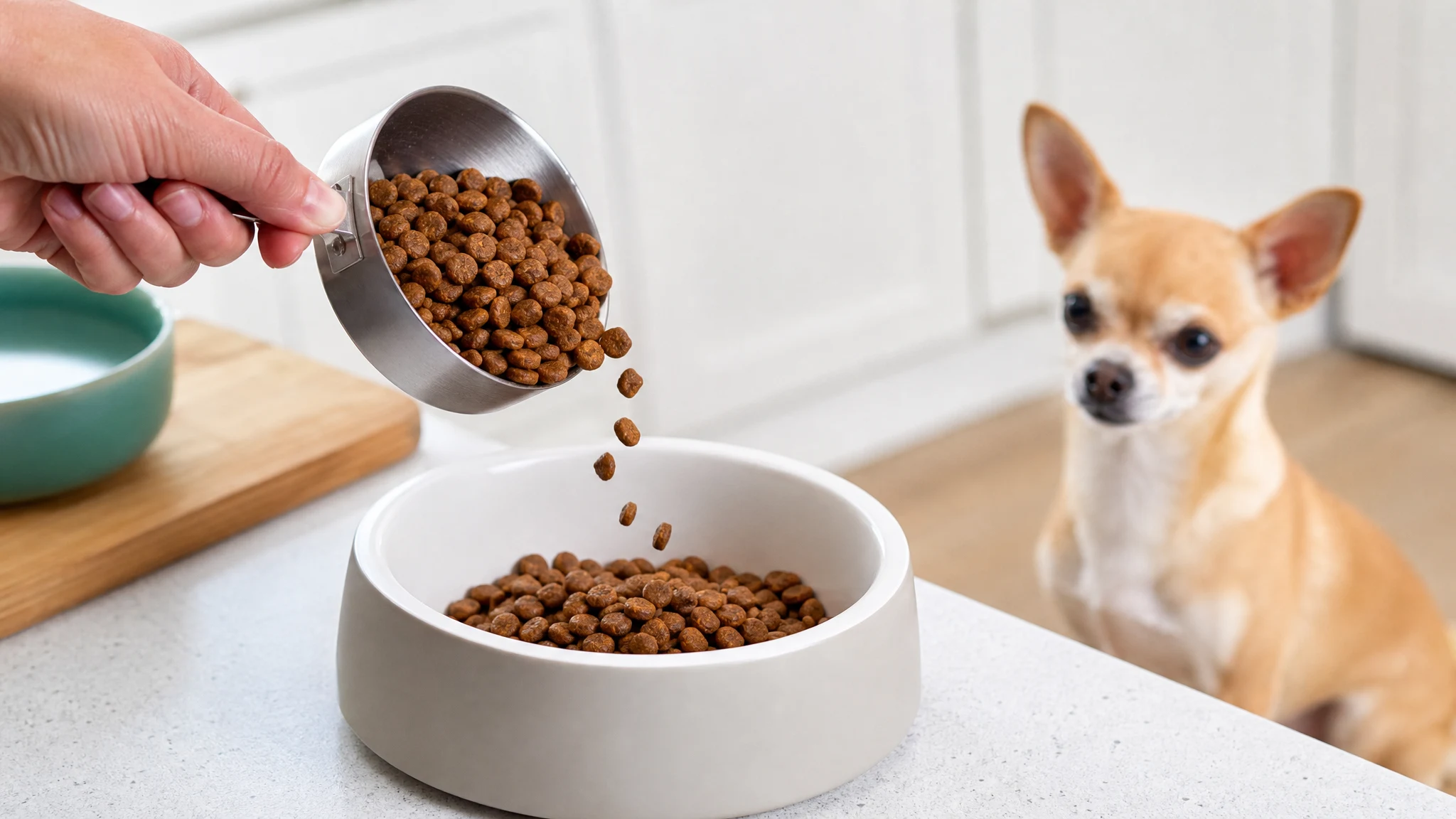
General nutrition information compiled from product labels and published sources, not veterinary advice. Your veterinarian is the right person to choose a diet for your dog, especially one with a health condition.
Working out how much to feed a Chihuahua is harder than it looks. The dogs are tiny, so a few extra kibbles are a big share of a day's food. Cup sizes also mean very different things from one food to the next.
This guide walks you through the steps. It includes a Chihuahua feeding chart built from the printed feeding guides of several foods. It also covers body condition scoring, activity changes and common mistakes.
One point first. Every number here is a starting point from a manufacturer's label. A veterinarian sets the amount for an individual dog.
How We Built This Chart
We compared label data and printed feeding guides. We did not run feeding trials or taste tests, and we did not feed any of these foods to dogs ourselves. The chart shows what each brand's own page says, nothing more.
Not every brand publishes the same kind of guide. Where a page gives no fixed amount for a small dog, we say so rather than guess.
Materials You Need
- A kitchen scale that reads in grams, or a standard dry measuring cup. A coffee mug or scoop from a bag is not a reliable measure.
- The bag, can or pack your dog eats, so you can read the calorie statement and feeding guide.
- A pet scale or a household scale for weighing your dog. One method is to weigh yourself, then weigh yourself holding the dog, and subtract.
- A notebook or phone note to log weight, amounts and treats.
- Your veterinarian's contact details, for the final amount and for any concerns.
Step 1: Know the Size You Are Feeding For
Hill's Pet Nutrition lists the Chihuahua at 2 to 6 pounds and says the breed seldom exceeds six pounds. Wikipedia notes the show maximum is 2.7 kg (5.9 lb) and that pet Chihuahuas sometimes exceed 4.5 kg (9.9 lb).
So a healthy pet Chihuahua may sit anywhere from the very small end up to around ten pounds. Frame size varies. A bigger number on the scale is not automatically a problem, and a smaller one is not automatically better.
Step 2: Pick the Right Life-Stage Food
Puppies and adults use different labels. Check the nutritional adequacy statement on the package, which says which life stage the food is formulated for.
- Royal Canin makes a Chihuahua Puppy dry food with a daily table by age (2 to 9 months) and target adult weight (2.2, 4.4 or 6.6 lb). Its page says to move to Chihuahua Adult food after 8 months.
- Hill's Science Diet Puppy Small & Mini covers puppies up to one year, according to its page.
- VICTOR Hi-Pro Plus Small & Medium Breed Puppy uses an age and weight chart.
These switch ages differ by brand. The age at which a Chihuahua counts as an adult is not something we can state for the breed, so ask your veterinarian when to change foods.
Growth labels must say either "including growth of large-size dogs (70 pounds or more as an adult)" or "except for growth of large-size dogs," as Whole Dog Journal explains. A Chihuahua is far below 70 pounds, so either wording is fine for the breed.
Step 3: Find the Calories on the Label
Calories per cup tell you how dense a food is. Here are the figures printed on the pages we compared:
- Royal Canin Chihuahua Adult dry: 323 kcal ME per cup (calculated).
- Royal Canin Chihuahua Puppy dry: 350 kcal ME per cup (calculated).
- Hill's Science Diet Adult Small & Mini: 357 kcal per cup.
- Hill's Science Diet Puppy Small & Mini: 418 kcal per cup.
- VICTOR Hi-Pro Plus Small Breed Adult: 360 kcal per cup.
- VICTOR Hi-Pro Plus Small & Medium Breed Puppy: 383 kcal per cup.
- Freshpet Small Dog Bite Size Chicken: 267 kcal per cup.
- Nom Nom Chicken Cuisine: 244 kcal per cup.
- Royal Canin Chihuahua Adult Loaf In Sauce: 77 kcal ME per can.
- JustFoodForDogs Pantry Fresh Chicken & Rice: about 31 kcal ME per ounce.
The spread is wide. A cup of the densest puppy food carries well over half again the calories of a cup of Nom Nom. This is why you cannot copy a cup amount from one brand to another.
Step 4: Use the Chihuahua Feeding Chart as a Starting Point
The table below uses only amounts printed on each brand's own page. The calorie column is simple arithmetic: the printed amount times the printed calories per cup. Treat it as an illustration of how much labels differ, not a prescription.
| Food and label used | Dog weight on the label | Printed amount per day | Approximate calories from that amount |
|---|---|---|---|
| Royal Canin Chihuahua Adult dry (Royal Canin product page) | 2.2 lb, low activity | 1/4 cup (24 g) | About 81 kcal |
| Royal Canin Chihuahua Adult Loaf In Sauce (Royal Canin product page) | 2.2 lb, low activity | 1 1/4 cans (96 g), canned food only | About 96 kcal |
| VICTOR Hi-Pro Plus Small Breed Adult (VICTOR product page) | 5 lb | 1/2 cup | About 180 kcal |
| VICTOR Hi-Pro Plus Small Breed Adult (VICTOR product page) | 10 lb | 1 cup | About 360 kcal |
| VICTOR Hi-Pro Plus Small & Medium Breed Puppy (VICTOR product page) | 6 lb puppy, 3 to 4 months | 1 cup | About 383 kcal |
| Freshpet Small Dog Bite Size Chicken (Freshpet product page) | 5 to 10 lb | 1/2 to 1 cup, in one or two meals | About 134 to 267 kcal |
| Nom Nom Chicken Cuisine (Nom Nom product page) | 10 lb, fed as the whole diet | 1 cup (218 g) | About 244 kcal |
Some brands do not give a simple amount for a Chihuahua-sized dog, so they are left out of the amounts above:
- Royal Canin Chihuahua Puppy has an age and target weight table on its page. Read that table on the brand page for your puppy's numbers.
- The Hill's Science Diet pages we compared say to transition over 7 days and adjust amounts to maintain optimal weight. Check the bag or brand page for the table.
- JustFoodForDogs points to a feeding calculator based on the dog's calorie needs rather than a fixed amount.
These are label guides for the products named, based on what each brand printed. A different brand of the same weight dog gets a different cup amount, as the table shows.
Step 5: Split the Day Into Small Meals
Divide the daily amount into more than one meal. Freshpet's page suggests one or two meals. Many owners of very small dogs prefer a few small meals. Your veterinarian can tell you how many are right for your dog.
Wikipedia lists hypoglycemia as a concern for toy-breed puppies. For that reason, do not stretch a puppy's meals far apart or skip them without asking your veterinarian first. If a puppy seems weak, shaky or unusually sleepy, call a veterinarian promptly.
Step 6: Check Body Condition Every Few Weeks
A scale tells you weight. Body condition scoring tells you whether that weight is carried well. Veterinary clinics use a numbered scale, and your veterinarian can show you where your dog falls on it. At home, use three quick checks:
- Feel the ribs. Run your hands along the sides of the chest. You should be able to feel the ribs under a thin layer of padding without pressing hard. If you have to dig for them, your dog may be carrying extra weight. If they stand out sharply, your dog may be thin.
- Look from above. A visible waist behind the ribs is a good sign. A straight or bulging outline can suggest extra weight.
- Look from the side. The belly should tuck up toward the hind legs. A belly that hangs level with the chest, or sags, is worth mentioning to your veterinarian.
Long coats and thick fur can hide shape, so rely on your hands as well as your eyes. Write the result in your notebook beside the date and weight.
Weight matters for more than looks. Wikipedia lists patellar luxation, a kneecap problem, as a condition where weight control is relevant. Your veterinarian decides what that means for an individual dog.
Step 7: Adjust for Activity
Some labels already build activity in. Royal Canin's adult tables list amounts by weight and activity level, and the 2.2 lb low-activity figure in the chart is one example. Most Chihuahuas are indoor dogs with short walks, so a low-activity row may fit many of them.
Use a simple approach:
- If your dog is on the heavier side of the body check and mostly rests, begin at the lower end of the label range.
- If your dog is lean and plays or walks a lot, the middle or upper end may fit better.
- Change the amount in small steps, and give each change a few weeks before judging it.
If your dog gains or loses weight and you are unsure why, ask your veterinarian before making larger changes.
Step 8: Count Treats and Toppers
For a 2.2 lb dog on the Royal Canin adult label, the day's food is only about 81 kcal by the arithmetic above. A few treats can be a real share of that. Take the treats out of the meal amount, or ask your veterinarian how much room to leave for them.
Table scraps add up even faster. Keep them out of the routine, and ask your veterinarian before sharing human food.
Step 9: Switch Foods Gradually
Several brands we compared recommend a gradual change. Hill's, Nom Nom and Royal Canin's neighbors in this list say to transition over about 7 days, and VICTOR says 7 to 10 days. Mix a little new food with the old and shift the balance each day.
Remember to recalculate the amount when you change. A cup of the new food will not carry the same calories as a cup of the old one.
Common Mistakes to Avoid
- Copying a cup amount between brands. The table shows how much calorie density varies.
- Estimating with a mug or scoop. At these tiny amounts, a rough pour is a large error. Weigh the food or use a proper measuring cup.
- Feeding by the dog's begging. Chihuahuas can be persuasive. Hunger behavior is not a reliable gauge of need.
- Forgetting treats. They count toward the day.
- Ignoring the life stage. A puppy food fed to an adult, or the reverse, changes the calorie intake. Hill's notes its puppy formula is not recommended for adult dogs or obese-prone dogs.
- Treating a label as a rule. A label is a starting point for a typical dog.
- Making health claims for a food. No food on the shelf is a treatment for a medical condition. Prescription diets are something only a veterinarian prescribes.
What to Expect
With a steady, measured routine, many owners find their dog's weight stays fairly stable over weeks. A dog on a well-matched amount often keeps a visible waist and ribs that can be felt under light padding. Results vary with each dog's age, activity, health and metabolism.
If your dog's weight drifts, the cause could be the amount, the treats, or a health issue. Let your veterinarian sort that out.
The FDA has an ongoing page about a possible link between certain diets and canine dilated cardiomyopathy. Its latest update is dated December 23, 2022, and the agency says reports alone are not enough to establish causation. If this concerns you, raise it with your veterinarian when you choose a food.
When to Call Your Veterinarian
Check in before changing the amount if your dog:
- is a puppy who refuses meals or seems weak,
- is gaining or losing weight without a clear reason,
- has a medical condition, or
- is pregnant or nursing.
Bring the food name, the amount you feed and the treats you give. That makes it easy for your veterinarian to set a daily amount for your individual dog.
Sources
- Royal Canin: Chihuahua Adult Dry Dog Food
- Royal Canin: Chihuahua Puppy Dry Dog Food
- Royal Canin: Chihuahua Adult Loaf In Sauce
- Hill's Pet Nutrition: Science Diet Puppy Small & Mini
- Hill's Pet Nutrition: Science Diet Adult Small & Mini
- Hill's Pet Nutrition: Chihuahua breed page
- VICTOR: Hi-Pro Plus Small Breed Adult
- VICTOR: Hi-Pro Plus Small & Medium Breed Puppy
- Freshpet: Small Dog Bite Size Chicken Recipe
- Nom Nom: Chicken Cuisine
- JustFoodForDogs: Pantry Fresh Chicken & Rice
- FDA Center for Veterinary Medicine: Investigation into diets and canine dilated cardiomyopathy
- Whole Dog Journal: In the Fine Print, Nutritional Adequacy Statements
- Wikipedia: Chihuahua (dog breed)