Dog Feeding Stations for Chihuahuas: What to Look For
General nutrition information compiled from product labels and published sources, not veterinary advice. Your veterinarian is the right person to choose a diet for your dog, especially one with a health condition.
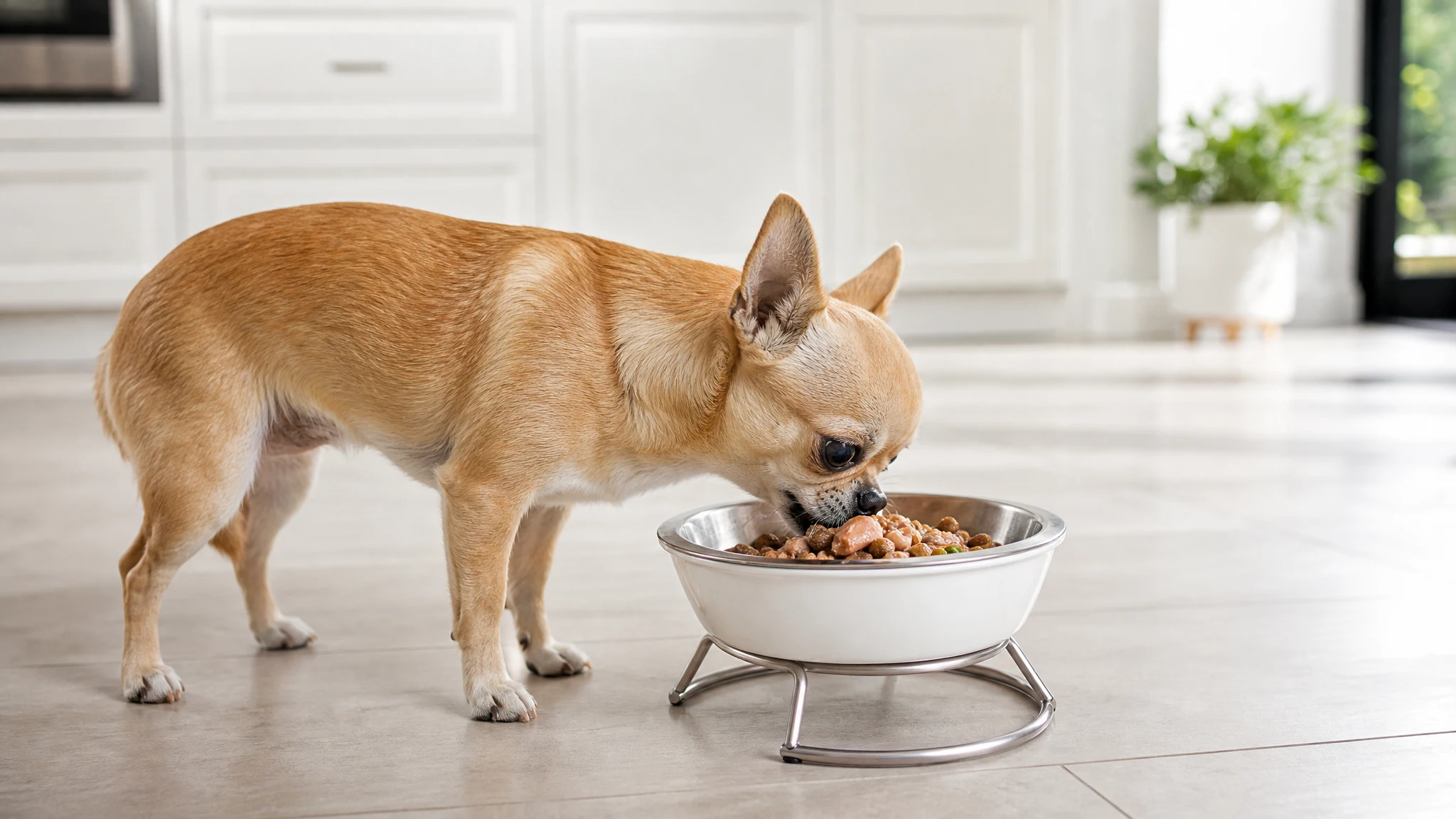
A dog feeding station is simply a set place where your dog eats and drinks. It usually has a food bowl, a water bowl, a mat, and sometimes a raised stand or storage bin. For a Chihuahua, the details matter more than they might for a larger dog.
Hill's Pet Nutrition lists adult Chihuahuas at 2 to 6 pounds, and says they seldom exceed six pounds. A bowl built for a Labrador is a poor fit for a dog that small. This guide walks through how to build a station sized for a Chihuahua, step by step.
It is a how-to, not a product roundup. We do not recommend or link to any bowl brands. We did not test any feeders ourselves. What we did compare is food label data, which helps you set up portions that fit your station.
What a Chihuahua feeding station needs to do
A good station does four jobs. It keeps the bowl steady, it fits a tiny mouth, it keeps portions measured, and it sits in a calm spot. Everything below serves one of those jobs.
Chihuahuas have a pointed muzzle and a small jaw. Royal Canin says as much on its US product page, where it describes its Chihuahua kibble as small-sized and designed for that muzzle and jaw. The same logic applies to bowls. Shape and depth should suit the face.
Materials you will need
- A shallow food bowl. Wide and low, so a small muzzle can reach the food without pushing against deep walls.
- A separate water bowl. Also small and stable, kept filled with fresh water.
- A non-slip mat. Catches spills and keeps bowls from sliding on tile or wood.
- Measuring cups or a kitchen scale. Label feeding guides are written in cups and grams, so you need a way to measure either one.
- An airtight container for dry food. Keeps the bag contents tidy. Keep the original bag or note the brand, recipe and lot information in case you need it later.
- A small raised stand (optional). Some owners like one for comfort. It is a preference, not a requirement.
- A notebook or phone note. For logging what and how much your dog eats.
Step 1: Pick bowls sized for a small face
Start with the dog, not the bowl. Look at your Chihuahua's muzzle and think about how the dog actually eats. A bowl that is too deep forces a small dog to dig, and the bowl may tip or slide as the dog pushes.
Look for these traits:
- Low sides so the dog can reach food without straining.
- A wide, flat base that resists tipping.
- A smooth surface that is easy to wash. Stainless steel and ceramic are common choices, and both are simple to clean.
- Enough room for one meal, not a bowl so large that food scatters across the bottom.
A Chihuahua's meal is tiny. For example, Royal Canin's feeding table for its adult dry food starts at 1/4 cup (24 g) per day for a 2.2 lb dog with low activity. A very small bowl handles that easily.
Step 2: Decide whether a raised stand makes sense
Some people raise bowls so a tiny dog does not have to reach down as far. Others find a floor-level bowl works fine. We found no source in our research that says one is better for Chihuahuas, so treat this as a comfort choice.
If you try a stand, check these points:
- The bowl should sit lower than your dog's chest, not above the head.
- The stand should not wobble. A tiny dog bumping a shaky stand can spill everything.
- Your dog should be able to eat without stretching or jumping.
If your dog has neck, back or joint concerns, ask your veterinarian what height is right. That is an individual call.
Step 3: Choose a stable, quiet location
Place the station away from foot traffic, a noisy washing machine, and the front door. Chihuahuas can be wary of sudden noise, and a calm spot helps meals go smoothly.
Other location tips:
- Put the mat on a hard floor that is easy to wipe.
- Keep the station away from the cat's litter box and from kids' play areas.
- Keep it somewhere you can see the dog eat, so you notice changes in appetite.
- Choose one spot and keep it. Dogs settle into routines.
Step 4: Set up portion tools and a measuring routine
Portions are where a feeding station earns its place. A Chihuahua is so small that a few extra kibbles are a large share of a day's food.
Label feeding guides are starting points. Here is what several brand pages say, so you can see how much the guides vary by recipe:
| Food (brand page) | Label guide example | Calories listed |
|---|---|---|
| Royal Canin Chihuahua Adult dry | 2.2 lb dog, low activity: 1/4 cup (24 g) | 323 kcal ME per cup, calculated |
| Royal Canin Chihuahua Adult loaf in sauce (canned) | 2.2 lb dog, low activity: 1 1/4 cans (96 g) | 77 kcal ME per can |
| VICTOR Hi-Pro Plus Small Breed Adult | 5 lb dog: 1/2 cup daily | 360 kcal per cup |
| Freshpet Small Dog Bite Size Chicken | 5 to 10 lb: 1/2 to 1 cup per day, in one or two meals | 267 kcal per cup |
Notice that a cup of one food is not a cup of another. The calorie counts differ, and so do the guides. Always use the guide on the bag or can your dog actually eats.
For age and weight detail, see our Chihuahua feeding chart by age and weight. If your dog has a health condition, confirm amounts with your veterinarian before you rely on any label guide.
Step 5: Set a meal schedule that fits the station
A station works best with a routine. Some label guides split the daily amount across meals. Freshpet's page, for example, says one or two meals. Royal Canin's puppy guide is organized by age from 2 to 9 months and by expected adult weight, and says to move to its Chihuahua Adult food after 8 months.
The Wikipedia breed entry mentions hypoglycemia as a concern in toy-breed puppies. We are not a medical source, and that entry is a secondary one. If you have a young puppy, ask your veterinarian how often to feed and what to do if your puppy seems weak or refuses food.
A general routine looks like this:
- Measure the meal at the same time each day.
- Put the bowl down and let your dog eat in peace.
- Pick up leftovers after a set time, so food does not sit out.
- Wash the bowls and refresh the water.
Step 6: Handle food transitions carefully
When you change foods, change them at the station slowly. Several brand pages give a timeline. Hill's Science Diet pages say to transition over 7 days. VICTOR says 7 to 10 days. Nom Nom says about 7 days.
Mix a little of the new food with the old, and shift the ratio over that period. Keep the bowls and mat the same, so the only thing changing is the food.
Step 7: Keep the station clean
Wash food and water bowls daily with hot water and dish soap. Dry them before refilling. Wipe the mat and the floor around it. Fresh and wet foods need extra care, since they should not sit out for long. Follow the storage directions on each brand's page.
Reading labels before you fill the bowl
The station is only half the picture. What goes in the bowl matters too, and labels deserve a skeptical eye.
- Look for the AAFCO statement. It tells you whether the food is for maintenance, growth, or all life stages.
- Check the large-size wording. Whole Dog Journal explains that growth and all-life-stages labels say either "including growth of large-size dogs (70 pounds or more as an adult)" or "except for growth of large-size dogs." A Chihuahua is far below 70 pounds, so the "except" wording is not a problem for this breed.
- Read the first ingredients. Royal Canin's adult dry food lists corn, chicken by-product meal, wheat gluten, oat groats and brewers rice first. VICTOR's small breed adult lists beef, chicken meal, beef meal, brown rice and whole grain millet. Neither list says anything about your dog's health on its own.
- Know what percentages mean. Hill's pages list protein and fat as dry matter averages, not guaranteed minimums. Do not compare those numbers directly with a guaranteed analysis.
We compared label data from brand pages. We did not run feeding trials or taste tests, so we cannot tell you how a particular dog will respond to a food.
On heart health, the FDA Center for Veterinary Medicine's last public update on its investigation into diets and canine dilated cardiomyopathy is dated December 23, 2022. The agency says reports alone are not enough to establish causation. If you have questions about a diet, ask your veterinarian.
Tips for a smoother feeding station
- Measure, do not eyeball. A scoop that looks small can hold more than the label suggests.
- Use one bowl per dog. In a multi-dog home, set stations apart so a small dog is not crowded.
- Keep treats counted. Treats add calories. The Wikipedia breed entry notes patellar luxation in the breed and says weight control is relevant, so extra calories deserve attention. Your veterinarian decides what is right for your dog.
- Watch the dog, not just the bowl. Track appetite in your notebook and mention changes at checkups.
- Use positive habits. Reward calm behavior near the bowl with praise. Never punish a dog for guarding or fussing at meals. If guarding is an issue, ask a qualified, reward-based trainer or your veterinarian for help.
Common mistakes to avoid
- Using a bowl that is too big or deep. It makes eating harder for a small muzzle and encourages scattering.
- Skipping the non-slip mat. A sliding bowl turns a meal into a chase.
- Free-feeding without measuring. It is hard to notice appetite changes when food is always available.
- Treating a label guide as exact. It is a starting point. Adjust with your veterinarian based on your dog's body condition and activity.
- Switching foods suddenly. Follow the transition timeline on the brand page.
- Feeding a puppy food to an adult. Hill's says its Puppy Small and Mini recipe is not recommended for adult dogs. Check the life stage on every label.
- Assuming an expensive feeder fixes a medical issue. No bowl or stand treats or prevents a disease.
What to expect
A well-set station may make meals calmer and cleaner. It may help you notice appetite changes sooner, and measured portions may make it easier to keep your dog at a steady weight. Results vary from dog to dog.
A feeding station does not replace veterinary care. If your Chihuahua stops eating, vomits, seems weak, or loses or gains weight, call your veterinarian. For a dog with a health condition, confirm both the food and the amounts with your vet.
Quick checklist
- Choose shallow, stable bowls sized for a small muzzle.
- Decide on floor level or a steady raised stand.
- Pick a quiet spot and keep it consistent.
- Measure portions using the guide on your dog's food.
- Set a regular schedule and pick up leftovers.
- Transition foods over about 7 to 10 days, as the brand directs.
- Clean bowls and the mat every day.
For official brand details, check each maker's own page, since recipes and guides can change. If a detail is not on the page, ask the brand or your veterinarian.
Sources
- Hill's Pet Nutrition: Chihuahua breed page
- FDA Center for Veterinary Medicine: Investigation into diets and canine dilated cardiomyopathy
- Royal Canin US: Chihuahua Adult dry dog food
- Royal Canin US: Chihuahua Puppy dry dog food
- Royal Canin US: Chihuahua Adult loaf in sauce
- VICTOR: Hi-Pro Plus Small Breed Adult
- Freshpet: Small Dog Bite Size Chicken Recipe
- Hill's Science Diet: Puppy Small and Mini
- Whole Dog Journal: Nutritional adequacy statements