Dog Feeding Chart for Chihuahuas: Amounts by Age
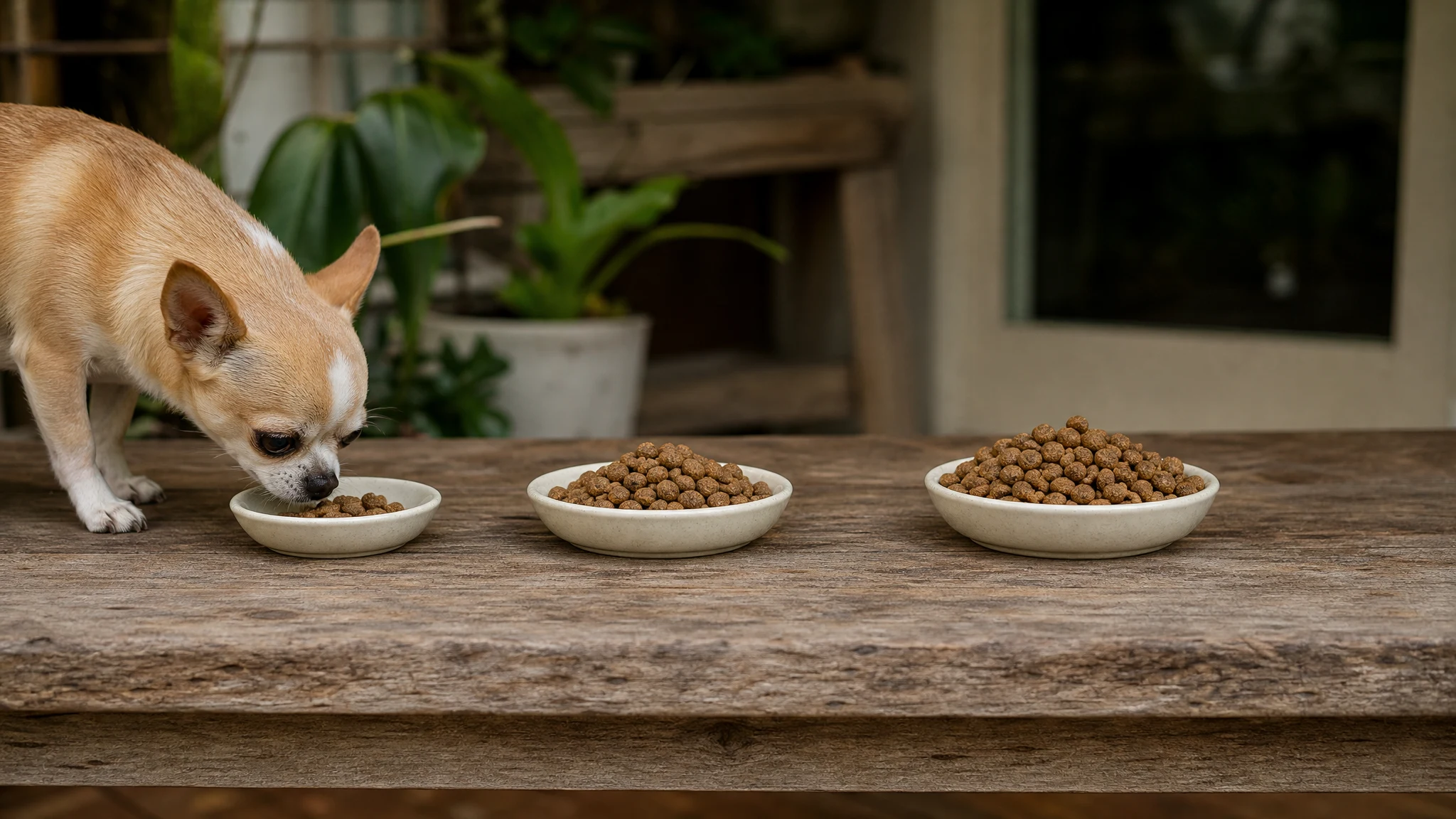
General nutrition information compiled from product labels and published sources, not veterinary advice. Your veterinarian is the right person to choose a diet for your dog, especially one with a health condition.
Chihuahuas are tiny, so a small mistake at the bowl is a big one. A few extra kibbles a day is a larger share of their food than it would be for a Labrador. A good dog feeding chart gives you a starting point, and you adjust from there.
This guide shows how to build a chart for your own dog. It uses the feeding guides printed by the brands themselves. It also explains how age, weight and activity change the numbers.
A note on method: we compared label data from brand pages. We did not run feeding trials or taste tests. Every amount below is a label starting point, not a prescription.
What a Chihuahua Feeding Chart Can and Cannot Do
A feeding chart on a bag is written for an average dog of a given weight. Your Chihuahua may be more or less active, or have a different build, than that average dog. So treat the chart as a first guess and watch your dog's body.
Size matters here. Hill's Pet Nutrition lists adult Chihuahuas at 2 to 6 pounds and says they seldom exceed six pounds. Pet Chihuahuas can run bigger than show dogs, though. Wikipedia notes that some pets exceed 9.9 pounds. Your dog may not match a textbook figure, so weigh your own.
Life expectancy numbers also vary by source. Hill's lists 14 to 18 years in its breed attributes, while its own About text says up to about 14. Wikipedia cites studies of roughly 8 to 12 years. Whatever the number, steady, sensible feeding across many years is the goal.
If you want a ready-made table to compare against, see our full feeding chart by age and weight. The steps below show how to turn any chart into a plan for your dog.
Materials You Need
- The bag, can or pack of the food you actually feed, with its feeding guide and calorie statement.
- A kitchen scale that reads in grams or ounces. Cups vary from scoop to scoop, so weighing is more reliable.
- A standard measuring cup, if you prefer cups.
- A recent weight for your dog. A bathroom scale works: weigh yourself, then weigh yourself holding your dog, and subtract.
- A notebook or phone note to track weight, portions and treats.
- Your veterinarian's contact details, for any health question.
Step-by-Step: Build Your Chihuahua's Feeding Chart
Step 1: Confirm the right life-stage food
Check the AAFCO statement on the label. It should say the food is complete and balanced for your dog's life stage. Puppies need a growth or all life stages statement. Adults need maintenance or all life stages.
AAFCO growth and all life stages labels must say whether they include growth of large-size dogs (70 pounds or more as an adult). Whole Dog Journal explains this wording. A Chihuahua is far below 70 pounds, so a label that says "except for growth of large-size dogs" is not a problem for this breed.
Step 2: Find your dog's current weight
Weigh your dog and write it down. For puppies, the brand tables usually ask for age and expected adult weight. Royal Canin's puppy table, for example, uses age from 2 to 9 months and adult weights of 2.2, 4.4 or 6.6 pounds. If you do not know the expected adult weight, ask your veterinarian for an estimate.
Step 3: Read the brand's own guide
Open the feeding table on the label or the brand's page. Find the row for your dog's weight (and age, for puppies). Note the amount and whether it is per day or per meal. This is the most commonly misread part of a label.
Here is how a few label guides compare. These are the brands' own examples, shown only to illustrate how much they differ.
| Food (brand page) | Label example | Calories on the label |
|---|---|---|
| Royal Canin Chihuahua Adult, dry | 2.2 lb dog, low activity: 1/4 cup (24 g) | 323 kcal ME per cup, calculated |
| Royal Canin Chihuahua Adult Loaf In Sauce, canned | 2.2 lb dog, low activity: 1 1/4 cans (96 g) | 77 kcal ME per can |
| VICTOR Hi-Pro Plus Small Breed Adult, dry | 5 lb dog: 1/2 cup daily. 10 lb dog: 1 cup daily | 360 kcal per cup |
| VICTOR Hi-Pro Plus Small & Medium Breed Puppy, dry | 6 lb puppy, 3 to 4 months: 1 cup per day | 383 kcal per cup |
| Freshpet Small Dog Bite Size Chicken, fresh | 5 to 10 lb: 1/2 to 1 cup per day, in one or two meals | 267 kcal per cup |
| Nom Nom Chicken Cuisine, fresh | 10 lb dog: 1 cup (218 g) per day on a full Nom Nom diet | 244 kcal per cup, calculated |
Notice that a cup of one food is not a cup of another. A cup of VICTOR adult is listed at 360 kcal, while a cup of Freshpet is listed at 267 kcal. Never carry a cup amount from one food to another. Always use the guide on the food you are actually buying.
Step 4: Adjust for age
Puppies and adults get different foods and different charts. Royal Canin's Chihuahua Puppy guide covers 2 to 9 months and says to move to its Chihuahua Adult food after 8 months. Royal Canin's adult formula is for purebred Chihuahuas 8 months and older. Hill's Science Diet Puppy Small & Mini is labeled for puppies up to 1 year. Brands draw the line at different ages, so follow the label for your food and ask your veterinarian when to switch. We did not find a single age at which a Chihuahua counts as an adult, so check with your vet or the Chihuahua Club of America.
Toy puppies can be prone to low blood sugar (hypoglycemia), according to Wikipedia. That is one reason to ask your veterinarian how often your puppy should eat, and what to do if your puppy seems weak or sleepy. We do not set a puppy meal schedule here because the sources we reviewed do not give one. Among the labels we compared, Freshpet says one or two meals a day for its small dog recipe, which is a label example and not a rule for puppies.
Step 5: Adjust for activity
Royal Canin's tables are split by activity level, which is why the 2.2 pound example above says low activity. A couch-loving Chihuahua and one that runs the yard all day do not need the same amount. Start at the row that fits your dog and adjust only after a few weeks of tracking.
Step 6: Split into meals and measure
Divide the daily amount into the number of meals your veterinarian recommends. Weigh the portion on your scale. If you use cups, level them off rather than heaping. Write down the number so every person in the home feeds the same amount.
Step 7: Count treats and extras
Treats, chews and table scraps add calories. For a dog of 5 pounds, even small extras matter. Reward-based training is a good use of treats, but cut them small. If your dog gets a lot of treats, reduce the meal portion a little to make room.
Step 8: Transition foods slowly
When you change foods, mix the new food with the old over about a week. Hill's and VICTOR both recommend a gradual change on their pages, about 7 days for Hill's and 7 to 10 days for VICTOR. A sudden switch can upset a small stomach.
Step 9: Weigh, check and adjust
Weigh your dog every couple of weeks at first. Look at body shape from above and from the side. If weight creeps up or down, change the portion slightly and check again. Hill's notes on its label to adjust portions to maintain optimal weight, which is the same idea.
Choosing a Food Format
The chart you build depends on the form of food. Here is how label data differs, based on what the brands publish.
- Small-breed dry food. Royal Canin states that its Chihuahua kibble is small-sized and designed for the breed's pointed muzzle and tiny jaw. Its adult formula lists corn, chicken by-product meal, wheat gluten, oat groats and brewers rice as the first five ingredients. VICTOR's Hi-Pro Plus Small Breed Adult lists beef first, with a guaranteed minimum of 30 percent protein and 14 percent fat. Hill's Science Diet Adult Small & Mini lists chicken first and says the texture is designed for small dogs.
- Canned food. Royal Canin's Chihuahua loaf in sauce lists 77 kcal per can. Its protein minimum is 7 percent, which looks low only because the food is mostly water.
- Fresh food. Freshpet, Nom Nom and JustFoodForDogs publish their own recipes. JustFoodForDogs does not give a fixed amount on its page. It points to a feeding calculator based on calorie needs, so use that tool or ask your veterinarian.
Percentages on different foods are hard to compare directly, because wet and fresh foods contain more water. Some Hill's figures are dry matter averages, not guaranteed minimums. Compare calories and the feeding guide before you compare protein numbers.
Tips for Better Results
- Weigh food in grams when you can. A tiny dog's portion can change a lot with a slightly heaped scoop.
- Keep the same bowl and the same scoop so your measure stays consistent.
- Write down treats for a week. Most owners are surprised by the total.
- Keep a record of your dog's weight alongside the portion. It makes vet visits easier.
- Ask your veterinarian to check your dog's body condition at each visit.
Common Mistakes to Avoid
- Feeding by the cup from a different food. Cup calories vary widely, as the table shows.
- Using the adult chart for a puppy, or the reverse. Check the AAFCO life-stage statement. Hill's says its Small & Mini puppy food is not recommended for adult dogs.
- Ignoring treats. They count toward the daily total.
- Treating the chart as a fixed rule. The label is a starting point. Your dog's body tells you more.
- Switching foods in one day. Make the change gradually.
- Chasing marketing words. Terms like "premium" or "natural" are not nutrition measures. Read the AAFCO statement, ingredient list and calories.
- Worrying about grain-free by default. The FDA has investigated a possible link between certain diets and canine dilated cardiomyopathy. Its last public update on the page was December 23, 2022, and it says reports alone are not enough to establish causation. Ask your veterinarian what is right for your dog.
Health Conditions and Your Vet
If your Chihuahua has a health condition, confirm all amounts with your veterinarian before you follow any chart. That includes dogs with a history of low blood sugar, digestive trouble, allergies, heart or kidney concerns, or joint problems. A food does not treat or prevent any of these. Your veterinarian decides what is right for an individual dog, including whether a prescription diet fits, which only a veterinarian can prescribe.
Wikipedia lists patellar luxation among conditions seen in the breed and notes weight control as relevant. Keeping a small dog lean is one practical thing owners can do, but it is not a cure or a guarantee. Ask your veterinarian what a healthy weight looks like for your dog.
Do not add supplements without asking your veterinarian first. This article gives no supplement amounts.
What to Expect
If you follow these steps, you may find that feeding becomes more consistent. Weighing portions and tracking weight can help you spot gradual changes early. Many owners find that a steady routine helps them keep their dog at a stable weight, though results depend on the individual dog.
Expect to adjust. Your first number is a guess from a label. Over several weeks, your dog's weight, energy and stool quality tell you whether the portion fits. Share those notes with your veterinarian, who can confirm the plan.
Quick Recap
- Pick a food with the right life-stage AAFCO statement.
- Weigh your dog.
- Read the brand's own feeding table.
- Adjust for age and activity.
- Measure meals on a scale.
- Count treats.
- Change foods slowly.
- Weigh and adjust every few weeks.
- Confirm with your veterinarian, especially if your dog has a health condition.
For a side-by-side table by age and weight, use our Chihuahua feeding chart by age and weight.
Sources
- Hill's Pet Nutrition: Chihuahua breed page
- Royal Canin: Chihuahua Adult dry
- Royal Canin: Chihuahua Puppy dry
- Royal Canin: Chihuahua Adult Loaf In Sauce
- Hill's Science Diet: Puppy Small & Mini
- Hill's Science Diet: Adult Small & Mini
- VICTOR: Hi-Pro Plus Small Breed Adult
- VICTOR: Hi-Pro Plus Small & Medium Breed Puppy
- Freshpet: Small Dog Bite Size Chicken Recipe
- Nom Nom: Chicken Cuisine
- JustFoodForDogs: Pantry Fresh Chicken & Rice
- FDA Center for Veterinary Medicine: Investigation into diets and canine dilated cardiomyopathy
- Whole Dog Journal: In the Fine Print, Nutritional Adequacy Statements
- Wikipedia: Chihuahua (dog breed)