Best Training Treats for Chihuahuas (and How Many to Give)
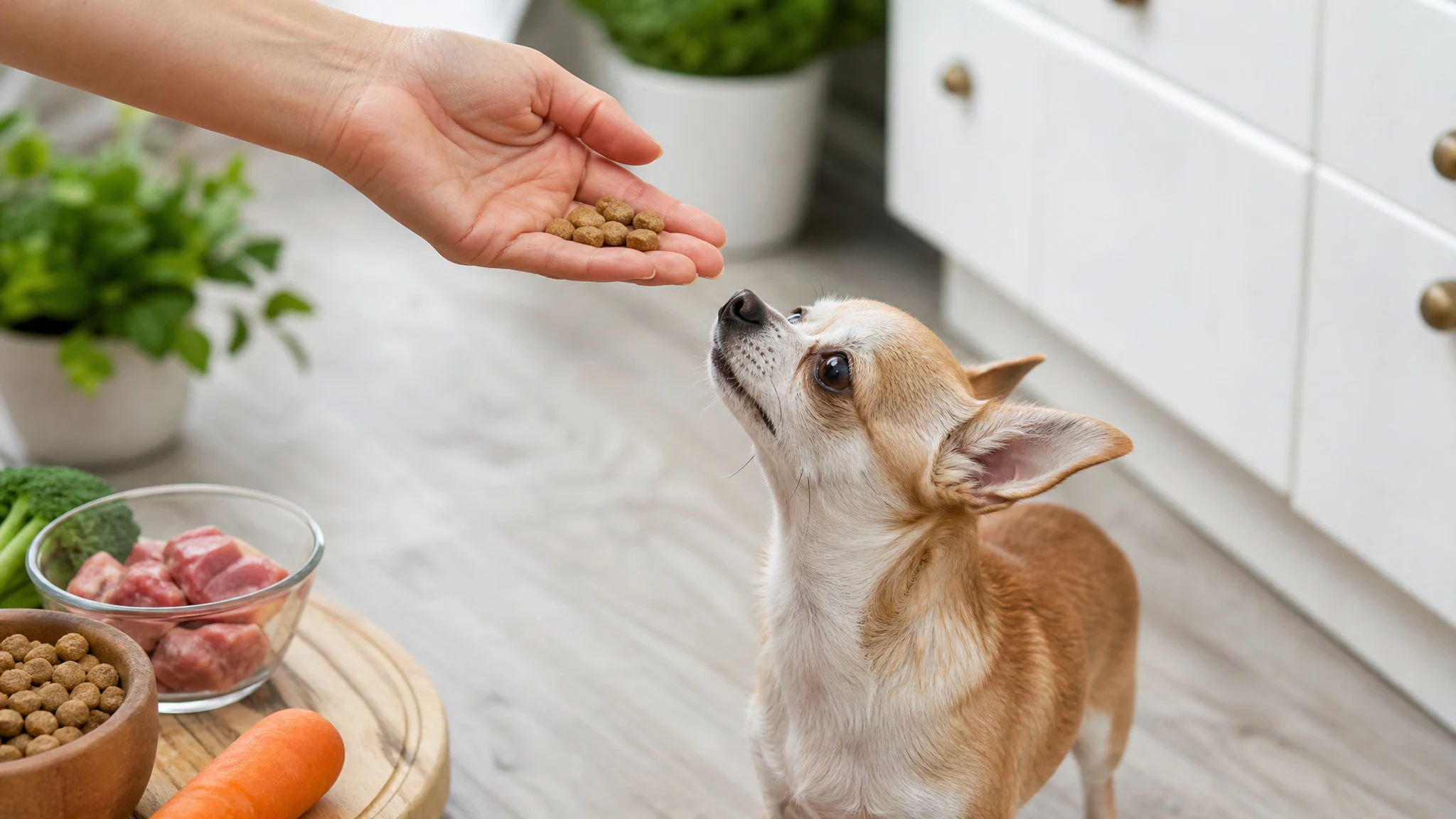
General nutrition information compiled from product labels and published sources, not veterinary advice. Your veterinarian is the right person to choose a diet for your dog, especially one with a health condition.
Chihuahuas are small, quick learners and often picky. Treats make training easy, but a tiny dog can also gain weight on them fast. The best treats for Chihuahuas are small, soft, easy to chew and counted as part of the day's food.
This guide shows how to pick treat types, cut them to the right size, work out a daily limit and use them in short training sessions. It does not rank brands. We did not feed or taste-test any treats, so it names no treat products and teaches you to read the label instead.
Why treat size and count matter for this breed
Hill's Pet Nutrition lists the Chihuahua at about 2 to 6 pounds and says the breed seldom exceeds six pounds. Wikipedia notes that pet Chihuahuas sometimes run heavier than the show standard. At that size, a few extra biscuits are a large share of a day's food.
Wikipedia also lists patellar luxation, a kneecap problem, among the conditions seen in the breed, and says weight control is relevant to it. It lists hypoglycemia (low blood sugar) as a concern in toy-breed puppies. Treats do not treat or prevent either condition. A veterinarian decides how to feed an individual dog, especially a young puppy, so ask your vet before changing a puppy's feeding routine.
Materials you need
- Two or three treat types from the categories below, so the dog does not get bored.
- A small cutting board and a sharp knife or kitchen scissors.
- A kitchen scale or measuring spoons, to weigh or measure your dog's daily food.
- The calorie information from your dog's regular food bag or brand page.
- A treat pouch or small container you can reach quickly.
- A notepad or phone note to log treats for the day.
The treat categories worth knowing
Soft training treats
Soft treats are easy to bite and swallow in one second, so the lesson keeps moving. A tiny dog with a small jaw does better with a treat that breaks apart than with a hard biscuit. Look for a short ingredient list and a calorie statement on the package. Many soft treats are rich, so cut them small.
Freeze-dried single-protein treats
These are pieces of one meat, such as chicken or beef, with the water removed. A single protein makes the ingredient list easy to read. If your dog has had trouble with certain foods, a single-ingredient treat is simpler to talk through with your vet. They crumble easily and are light, which suits tiny mouths. Check that the package says what it is made from and gives calories.
Vegetables
Some dogs accept small pieces of plain, cooked or raw vegetable as a low-calorie reward, such as a thin slice of carrot or a bit of green bean. Not every dog likes them, and not every vegetable is safe for dogs. Onions, garlic, grapes and raisins are well-known problems. Ask your vet which ones suit your dog before you start.
Step-by-step: choosing and using treats
Step 1: Find your dog's daily calorie target on the food label
Start with the regular food. Brand pages give calories per cup and a feeding guide. For example, the Royal Canin Chihuahua Adult dry food page lists 323 kcal ME per cup, as fed (calculated), and a feeding table by weight and activity. It shows 1/4 cup (24 g) for a 2.2 pound dog with low activity. Treat that as a starting point, not a rule for your dog.
If you feed a different food, use that brand's page or bag. Your vet can confirm what daily amount fits your dog's age, weight and build.
Step 2: Set a treat limit of about 10 percent of daily calories
The World Small Animal Veterinary Association (WSAVA) is commonly cited for the guideline that treats should make up no more than about 10 percent of a dog's daily calories, with the rest coming from a complete and balanced diet. Check with your vet that this fits your dog.
Here is the arithmetic using the label figures above. A quarter cup of a 323 kcal per cup food is roughly 81 kcal. Ten percent of that is roughly 8 kcal for the whole day. That is very little. Some single treats on the market contain several calories each, so one careless handful could use the whole allowance.
Your own numbers will differ. Divide your dog's daily calories by ten, and use that as the ceiling for all treats, chews and table scraps combined.
Step 3: Read the treat label
Look for the calories per treat or per piece. Without it, you cannot do the math from Step 2. Then check these points:
- A complete ingredient list with the main ingredient first.
- A calorie statement, such as kcal per treat or per kilogram.
- Texture that is soft or crumbly rather than hard and brittle.
- No claims that the treat cures or prevents a health problem. A treat cannot do that.
If calories are missing, check with the brand before you buy.
Step 4: Cut every treat to a tiny size
For a dog this small, cut treats to about the size of a pea or smaller. Use scissors on soft treats and crush freeze-dried pieces with your fingers. A dog does not need a big bite to know it was rewarded. The speed and the praise do most of the work.
Tiny pieces also let you do many repetitions of a skill, which is how dogs learn. Fifteen small rewards can cost fewer calories than one large biscuit.
Step 5: Subtract treats from meals on training days
If a training session uses a lot of treats, cut back the regular meal a little to match. Use the label guide as your starting point and adjust slowly. Watch the dog's body shape and talk to your vet if you are unsure.
Do not skip meals to make room for treats. This matters most for puppies, because Wikipedia notes hypoglycemia as a concern in toy-breed puppies. Keep puppy meal timing as your vet advises.
Step 6: Use treats in short, reward-based sessions
Keep sessions to a few minutes. Mark the behavior you want with a cheerful word like "yes," then give the treat right away. This is the reward-based approach supported by the American Veterinary Society of Animal Behavior (AVSAB). Do not use pain, fear or force.
- Hold a treat near the dog's nose.
- Ask for one simple behavior, such as sit.
- Say "yes" the moment the behavior happens.
- Deliver the treat low and close, so a tiny dog does not have to jump.
- Stop while the dog is still interested.
Step 7: Fade the treats as the skill improves
Once the dog performs a behavior reliably, reward it only some of the time. Mix in praise, a toy or a short game. This lowers the calories and usually keeps the dog interested.
Step 8: Log the day's treats
Write down what you gave, including bits from family members. Small dogs gain weight slowly and the change is easy to miss. A quick log shows whether you are staying under your ceiling.
Tips for better results
- Rotate rewards. Keep a higher-value treat for harder tasks and a plain kibble from the daily meal for easy ones.
- Use part of the regular meal. Measured kibble from the bag counts toward the day's food and is already accounted for. If you feed a Chihuahua-specific food, the kibble is designed small. Royal Canin describes its Chihuahua Adult kibble as small-sized, made for the breed's pointed muzzle and tiny jaw.
- Warm up soft treats. A very dry or stale treat can be hard to chew.
- Introduce new treats one at a time. If the dog has stomach upset, you will know the cause.
- Offer fresh water with dry or freeze-dried treats.
Common mistakes to avoid
- Using treats sized for bigger dogs. A full-size biscuit may be a large part of a toy dog's daily calories.
- Not counting calories from treats. Dental chews, scraps and training bits all count.
- Replacing meals with treats. Treats are not a complete diet. Look for the AAFCO statement on the food, which tells you whether it is complete and balanced for the life stage.
- Trusting front-of-bag claims. Words like "natural" or "premium" do not tell you the calories or the amount of any ingredient.
- Treating health worries with treats. No treat treats or prevents joint, heart, skin or stomach problems. Bring concerns to your vet.
- Using harsh corrections. Shock, prong or choke collars, alpha rolls and scruffing are not part of reward-based training.
What results to expect
With tiny, well-timed rewards and short sessions, many Chihuahuas pick up simple cues such as sit, come and look at me within a few weeks of regular practice. Progress varies a lot by dog, age and household. Some dogs are slow to warm up, and that is normal.
Keeping treats within a set calorie limit may help a dog hold a steady weight, which your vet can confirm at checkups. It will not guarantee a result for any individual dog.
Matching treats to the main diet
Treats work best when they fit around a complete food. If you are still choosing that food, our label-by-label comparison of dog foods for Chihuahuas explains how we compared label data such as AAFCO statements, ingredients and calories. We did not run feeding trials or taste tests.
When the main food is higher in calories, the treat budget gets smaller, so check both labels together. For a puppy, an older dog or a dog with a health condition, ask your veterinarian before changing the diet or treat plan. Prescription diets are only something a veterinarian can prescribe.
Quick checklist
- Find daily calories from the food label and your vet.
- Divide by ten for the treat ceiling.
- Pick soft, freeze-dried single-protein or vegetable options with clear labels.
- Cut every piece to pea size or smaller.
- Reduce meals slightly on heavy training days, except as your vet directs for puppies.
- Reward calmly, keep sessions short and log the day's treats.