The Best Dog Food for Chihuahuas, Compared Label by Label
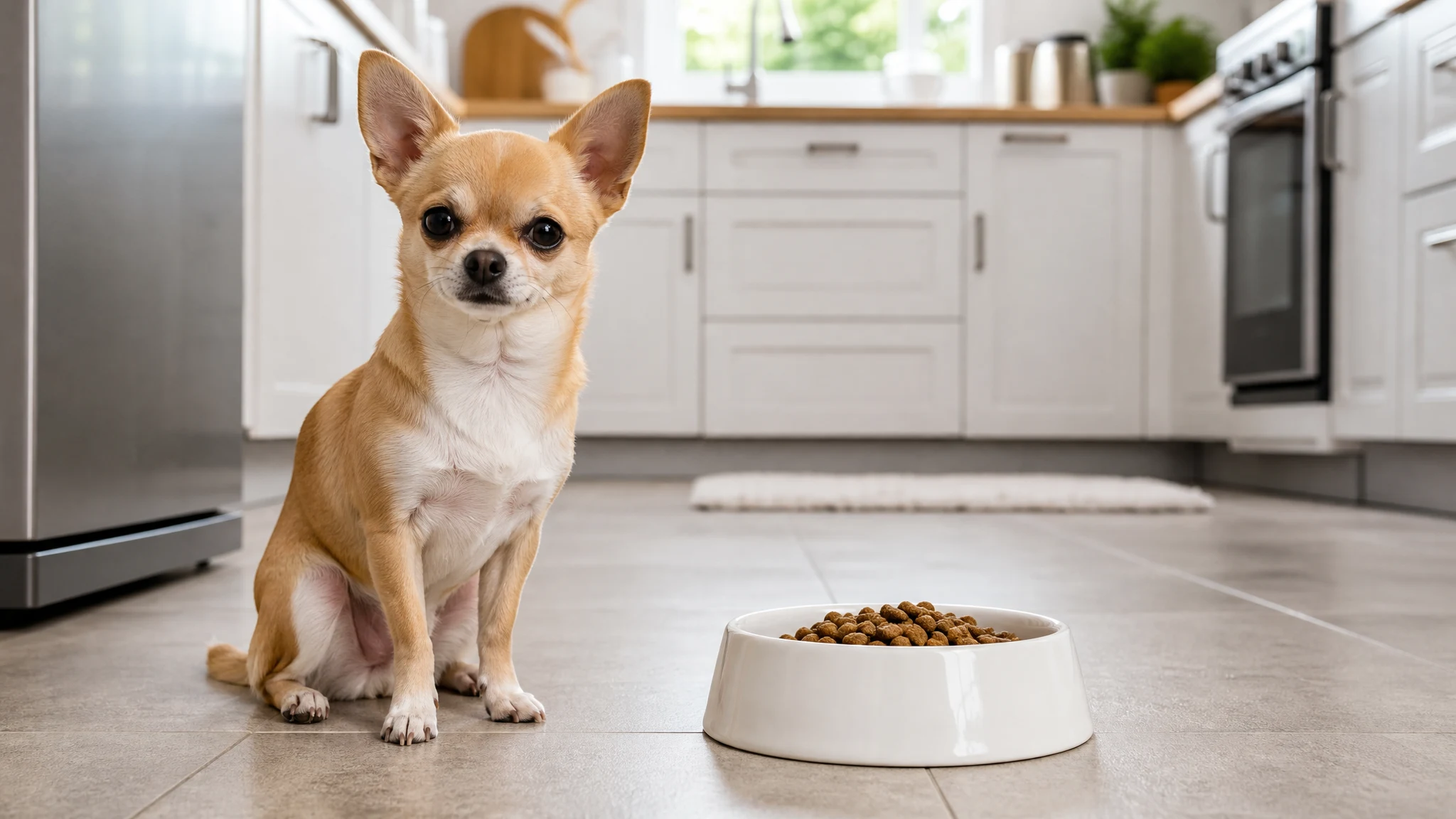
General nutrition information compiled from product labels and published sources, not veterinary advice. Your veterinarian is the right person to choose a diet for your dog, especially one with a health condition.
Anyone shopping for the best dog food for Chihuahuas meets a wall of confident claims. Bags say "premium," "natural" and "tiny breed." Few of them say what is actually in the bowl.
This guide skips the slogans and reads the labels. It covers what to look for, how the options line up, which food suits which situation, and what to be wary of. It is written for people who want to understand chihuahua food, not just pick a bag.
How we compared these foods
Here is the method, stated plainly. We compared published label data from each brand's own product page. That means the AAFCO nutritional adequacy statement, life stage, first ingredients, guaranteed protein and fat, calories, and kibble size where the brand states it.
We did not run feeding trials. We did not do taste tests. We did not feed any of these foods to dogs. Nothing here says how a food performs in a real bowl or how a particular dog reacts to it.
That limit matters. A label tells you what the maker claims and what the formula is built to meet. It cannot tell you whether your dog likes it, digests it well, or keeps a steady weight on it. A veterinarian who knows your dog decides those questions.
Prices are not compared. Prices change often and vary by store and size, so check each brand's own page. Where a brand did not publish a detail, such as kibble size, we say so rather than guess.
What to know about Chihuahuas before you read a label
The breed's size shapes almost every feeding choice.
- Very small adults. Hill's Pet Nutrition lists adult Chihuahuas at about 2 to 6 pounds and says they seldom exceed six pounds. Wikipedia notes the show maximum is about 5.9 lb, and that pet Chihuahuas sometimes exceed 9.9 lb.
- Toy size. At this weight a Chihuahua is a toy-sized dog. Small mouths and tiny portions both matter.
- Not a large-breed puppy. The large-breed growth wording on labels is aimed at dogs expected to reach 70 pounds or more. Whole Dog Journal explains that growth and all-life-stages foods must say either that they include growth of large-size dogs or that they exclude it. A label that says "except for growth of large-size dogs" is no problem for a Chihuahua.
- Weight and joints. Wikipedia lists patellar luxation, a kneecap problem, as a concern in the breed and notes that weight control is relevant. A vet decides what that means for an individual dog.
- Young puppies. Wikipedia also lists low blood sugar (hypoglycemia) as a concern in toy-breed puppies. If your puppy seems weak, wobbly or unusually sleepy, call a veterinarian instead of adjusting the diet yourself.
Sources disagree on lifespan. Hill's lists 14 to 18 years in its breed attributes, but its own About text says up to about 14. Wikipedia cites studies of roughly 8 to 12 years. We would not build a feeding plan around any single figure.
We could not confirm an official adult age or a breed-club diet statement. For those, check with the American Kennel Club, the Chihuahua Club of America, or your veterinarian.
What to look for on a label (quality indicators)
1. A complete and balanced statement
Find the AAFCO statement, usually in small print near the ingredients. It should say the food is formulated to meet the AAFCO Dog Food Nutrient Profiles, or that feeding tests substantiate it, for a named life stage. Without this wording, the product may be a treat or a topper, not a full diet.
2. The right life stage
Match the stage to your dog. "Growth" or "puppy" for puppies. "Maintenance" or "adult" for adults. "All life stages" can work for either, but it is built to cover puppy needs, so it may be richer than an adult needs.
3. The first five ingredients
Ingredients are listed by weight before cooking. That makes fresh meats look heavy at the top, since they contain water. A meal, such as chicken meal, is already dried down. Neither is automatically better. Read the whole list and ask what the food is built from.
4. Protein, fat and calories together
Percentages alone mislead. A tiny dog eating a small cup of a calorie-dense food can overshoot energy needs quickly. Look at kcal per cup and compare it with the feeding guide.
5. Kibble size
For a dog with a pointed muzzle and a tiny jaw, kibble size is a practical feature. Some brands state it, some do not. When a brand does not, treat the size as unknown.
Key features to compare at a glance
The table below covers the dry foods. Protein, fat and fiber are labeled as the brand states them. Hill's lists dry matter averages, not guaranteed minimums, so those numbers are not directly comparable with the others.
| Food | Life stage on label | First ingredients | Protein / fat | Calories |
|---|---|---|---|---|
| Royal Canin Chihuahua Adult (dry) | Adult, maintenance | Corn, chicken by-product meal, wheat gluten, oat groats, brewers rice | 26% min / 14% min | 323 kcal per cup |
| Royal Canin Chihuahua Puppy (dry) | Growth | Chicken by-product meal, brewers rice, chicken fat, corn, wheat gluten | 28% min / 18% min | 350 kcal per cup |
| Hill's Science Diet Adult Small & Mini Chicken & Brown Rice | Adult, maintenance | Chicken, brown rice, whole grain wheat, whole grain corn, brewers rice | 25% / 15.3% (dry matter) | 357 kcal per cup |
| Hill's Science Diet Puppy Small & Mini Chicken & Brown Rice | Growth, plus pregnant or nursing dogs | Chicken, whole grain oats, brown rice, chicken meal, chicken fat | 28.9% / 19.7% (dry matter) | 418 kcal per cup |
| VICTOR Hi-Pro Plus Small Breed Adult | All life stages, except large-size growth | Beef, chicken meal, beef meal, brown rice, whole grain millet | 30% min / 14% min | 360 kcal per cup |
| VICTOR Hi-Pro Plus Small & Medium Breed Puppy | All life stages, except large-size growth | Beef, chicken, beef meal, chicken meal, whole grain sorghum | 30% min / 18% min | 383 kcal per cup |
Two things stand out. First, the calorie range across these dry foods runs from 323 to 418 kcal per cup. For a dog that eats a quarter cup or less, that difference adds up. Second, only Royal Canin builds a formula specifically for the breed. The others are small-breed or small-and-mini recipes.
Top picks by situation
These are not rankings of quality. They are label-based matches for common situations. No pick is promised to work for every dog.
Adult dogs: a breed-specific dry option
Royal Canin Chihuahua Adult (dry). The brand says this is for purebred Chihuahuas 8 months and older. The label states it is formulated to meet the AAFCO profiles for maintenance. Protein is 26% minimum, fat 14% minimum, fiber 3.6% maximum, and it has 323 kcal per cup, the lowest per cup of the dry foods compared here.
The first ingredients are corn, chicken by-product meal, wheat gluten, oat groats and brewers rice. If you prefer whole meat first on the list, this is not that. If you want a formula sized for the breed, with a small kibble the brand designed for the Chihuahua's pointed muzzle and tiny jaw, it fits. The brand's feeding table runs from 2.2 lb to 7.7 lb by activity level. For example, a 2.2 lb dog with low activity is listed at 1/4 cup (24 g).
See the brand's Chihuahua Adult page.
Adult dogs: a small-breed option with meat first
Hill's Science Diet Adult Small & Mini Chicken & Brown Rice. Hill's states that feeding tests using AAFCO procedures substantiate it for adult maintenance. The first ingredients are chicken, brown rice, whole grain wheat, whole grain corn and brewers rice. It has 357 kcal per cup. The page says the texture is designed for small dogs' preferences but gives no kibble size in numbers, so check with Hill's if size matters for your dog.
See the Hill's adult page.
Adult dogs: a higher-protein small-breed option
VICTOR Hi-Pro Plus Small Breed Adult. This label is for all life stages, except growth of large-size dogs, which is fine for a Chihuahua. It lists 30% protein minimum, 14% fat minimum and 5% fiber maximum, at 360 kcal per cup. The first ingredients are beef, chicken meal, beef meal, brown rice and whole grain millet. The brand describes the kibble as bite-sized and nutrient-dense but gives no measurement.
VICTOR's feeding guide lists 1/2 cup a day for a 5 lb dog and 1 cup for a 10 lb dog, with a transition over 7 to 10 days. Treat that as a starting point, and keep in mind that an all-life-stages formula is built to cover growth, so it can be more than an adult needs. See the VICTOR product page.
Puppies
Three labels fit a small-breed puppy.
- Royal Canin Chihuahua Puppy (dry). Formulated for growth, with 28% protein minimum, 18% fat minimum and 350 kcal per cup. Its feeding table covers ages 2 to 9 months by target adult weight (2.2, 4.4 or 6.6 lb), and the brand says to move to Chihuahua Adult after 8 months. The kibble is small and made for a puppy's miniature jaw. See the Chihuahua Puppy page.
- Hill's Science Diet Puppy Small & Mini Chicken & Brown Rice. Feeding-test substantiated for growing puppies and for pregnant or nursing adult females. It has 418 kcal per cup, the highest of the group. Kibble size is not stated. The page says it is not recommended for adult dogs or for dogs prone to obesity. See the Hill's puppy page.
- VICTOR Hi-Pro Plus Small & Medium Breed Puppy. Labeled for all life stages, except large-size growth, with 30% protein minimum, 18% fat minimum and 383 kcal per cup. The page says only "appropriate kibble size" for small and medium breeds. It gives an example of 1 cup a day for a 6 lb puppy aged 3 to 4 months, which is large for a Chihuahua puppy, since Chihuahuas often finish well under that weight. Use your puppy's expected adult size and your vet's advice. See the VICTOR puppy page.
Very young toy puppies can have trouble if they go too long between meals. Ask your veterinarian how often to feed yours.
Senior dogs
None of the products compared here is labeled specifically for senior dogs. The adult formulas above are maintenance foods. We have no label data to say any of them suits an older dog better than another. Ask the brands whether they make a senior formula, and ask your veterinarian what an older dog needs.
Weight control
We have no label comparison for a weight-management formula, and we will not call a regular food one. What the labels do show is calorie density, which is the number to watch on a dog this small.
- Among dry foods, calories per cup range from 323 (Royal Canin Adult) to 418 (Hill's Puppy).
- Hill's states its puppy formula is not recommended for dogs prone to obesity.
- Fresh foods list fewer calories per cup, but a cup of a moist food is not the same as a cup of kibble. Compare daily calories, not cups.
Because weight control is relevant to kneecap problems in the breed, ask your vet for a target weight and a daily calorie goal. Then use the brand's feeding guide as a starting point.
Sensitive stomachs
None of the labels we compared makes a sensitive-stomach claim, and we have no data on digestibility. We cannot say any of these foods is gentler than another.
If your Chihuahua has loose stools, vomiting or itching, see a veterinarian first. Prescription diets exist for medical needs, but only a veterinarian prescribes them. Whatever you pick, each brand advises a gradual change, and several give 7 days as a guide. Hill's and Nom Nom say about 7 days, and VICTOR says 7 to 10.
Wet food
Royal Canin Chihuahua Adult Loaf In Sauce (canned). Formulated for maintenance in adult Chihuahuas over 8 months. The first ingredients are water sufficient for processing, chicken by-products, pork by-products, chicken and pork liver. Protein is 7% minimum, fat 4.1% minimum and fiber 2.3% maximum. A can has 77 kcal, and the cans are listed at 3 oz in a search listing, so confirm the size on the brand's page.
The brand's canned-only chart lists 1 1/4 cans (96 g) for a 2.2 lb dog with low activity. Whether the recipe is grain-free is not stated, so check with Royal Canin if that matters to you. Low percentages are normal for canned food because of the water, so do not compare its protein number directly with dry food. See the Chihuahua Loaf In Sauce page.
Fresh food
Three fresh foods appear in the label data. Each has a different focus.
| Food | Life stage on label | First ingredients | Protein / fat min | Calories |
|---|---|---|---|---|
| Freshpet Small Dog Bite Size Chicken Recipe | All life stages, except large-size growth | Chicken, chicken liver, carrots, cranberries, eggs | 16% / 12% | 267 kcal per cup |
| Nom Nom Chicken Cuisine | All life stages, including large-size growth | Chicken, sweet potatoes, squash, spinach, dicalcium phosphate | 6.5% / 4.5% | 244 kcal per cup |
| JustFoodForDogs Pantry Fresh Chicken & Rice | All life stages, including large-size growth | Chicken breast, chicken thighs, chicken liver, long-grain white rice, kale | 6.5% / 2.5% | About 31 kcal per ounce |
Freshpet Small Dog Bite Size Chicken Recipe is the only one made for small dogs. It is cut into bite-sized pieces, though no size is given, and the brand lists it as grain-free. Its guide runs from 1/2 to 1 cup a day for a 5 to 10 lb dog, in one or two meals. See the Freshpet page.
Nom Nom Chicken Cuisine is a general recipe with portions scaled to weight. Its page gives 1 cup (218 g) a day for a 10 lb dog on an all-Nom Nom diet, with a transition over about 7 days. The page makes no grain-free claim. See the Nom Nom page.
JustFoodForDogs Pantry Fresh Chicken & Rice gives no fixed amount. It points to a feeding calculator based on calorie needs. A 12.5 oz pack holds about 387.5 kcal. See the JustFoodForDogs page.
The protein and fat numbers for moist foods are not comparable with dry foods without a dry matter conversion. Those foods are mostly water.
Price points: what we can and cannot say
Buyer's guides often sort picks into budget, mid-range and premium. We cannot do that honestly here. We did not collect prices, and prices differ by store, bag size and subscription.
What you can do is compare cost per day. Take the price of the package from the brand's own page and divide by the number of days it lasts at your dog's feeding amount. A Chihuahua eats very little, so a bag can last a long time. Cost per day is often more telling than the sticker price.
As a rule of thumb from the format alone, dry food tends to be the simplest to store and portion. Fresh food usually asks more of the buyer in storage and ordering, and the brands set their own terms. We make no price claims either way.
Red flags to avoid
- No AAFCO statement. Without one, you cannot tell if the food is complete and balanced.
- The wrong life stage. A puppy needs a growth or all-life-stages label. An adult does not need extra calories from a growth food. Hill's states its own puppy formula is not for adults.
- Medical promises. A bag or site that claims to prevent, treat or cure a disease is overreaching. Diet can be part of a vet's plan, but a food is not a cure.
- Vague ingredient wording. Look for named ingredients you can identify. If you cannot tell what is in it, ask the brand.
- Cups without calories. A feeding guide that does not tell you calories makes it hard to compare foods or adjust portions.
- Guarantees. Any promise of perfect results for every dog is marketing, not nutrition.
- Giant kibble. If a brand does not state kibble size, look at the pieces yourself before buying a big bag for a 5 lb dog.
A note on grain-free labels
Grain-free is a marketing term, not a quality score. Of the foods here, the Freshpet recipe is listed as grain-free. Royal Canin dry, Hill's, VICTOR and JustFoodForDogs are not. Nom Nom and the Royal Canin wet loaf do not say.
The FDA has investigated a possible link between certain diets and canine dilated cardiomyopathy (DCM). The latest update on its page is dated December 23, 2022. The FDA says it does not plan further public updates until there is meaningful new scientific information, and that the reports alone are not enough to establish causation. We did not check for newer updates beyond that page, so read the FDA page itself and talk to your veterinarian before changing diets over this issue.
Where to buy
The simplest rule is to start at the brand's own site. The product pages linked above are the best place to confirm the current formula, ingredients, package sizes and feeding guide, since recipes and labels can change.
Each brand sets its own sales terms, and we have not verified who stocks what in your area. To find a store, use the locator or ordering page on the brand's site, or call the brand. Whichever store you use, check the package label against the brand page, look at the best-by date, and avoid dented or damaged packaging.
Buying the smallest size first is a sensible way to test a new food on a dog this small. It limits waste if your Chihuahua turns it down.
How to switch foods safely
- Check the life stage on the new label before you buy.
- Mix a little new food into the old one. The brands here suggest about 7 days for a switch, and VICTOR says 7 to 10.
- Measure portions with a proper measuring cup or a kitchen scale. A few extra kibbles mean a lot to a 5 lb dog.
- Treat the feeding guide as a starting point, then adjust with your veterinarian based on your dog's body condition.
- Call your vet if your dog refuses food, vomits, has diarrhea, or seems weak after a change.
The short version
The best food for Chihuahuas is the one whose label matches your dog's life stage, whose calories fit your dog's size, and whose kibble or texture your dog can manage. In the label data we compared, Royal Canin is the only brand with Chihuahua-specific dry formulas for both puppies and adults, plus a Chihuahua canned loaf. Hill's and VICTOR offer small-breed alternatives. Freshpet, Nom Nom and JustFoodForDogs offer fresh options with different designs.
None of that tells you how your own dog will do. That takes a vet's guidance and careful watching of your dog's weight, energy and stools over time.
Sources
- Royal Canin: Chihuahua Adult Dry Dog Food
- Royal Canin: Chihuahua Puppy Dry Dog Food
- Royal Canin: Chihuahua Adult Loaf In Sauce
- Hill's Pet Nutrition: Science Diet Puppy Small & Mini
- Hill's Pet Nutrition: Science Diet Adult Small & Mini
- Hill's Pet Nutrition: Chihuahua breed page
- VICTOR: Hi-Pro Plus Small Breed Adult
- VICTOR: Hi-Pro Plus Small & Medium Breed Puppy
- Freshpet: Small Dog Bite Size Chicken Recipe
- Nom Nom: Chicken Cuisine
- JustFoodForDogs: Pantry Fresh Chicken & Rice
- FDA Center for Veterinary Medicine: Investigation into diets and canine dilated cardiomyopathy
- Whole Dog Journal: In the Fine Print, Nutritional Adequacy Statements
- Wikipedia: Chihuahua (dog breed)