Best Food for Dog Gut Health: A Chihuahua-Specific Guide
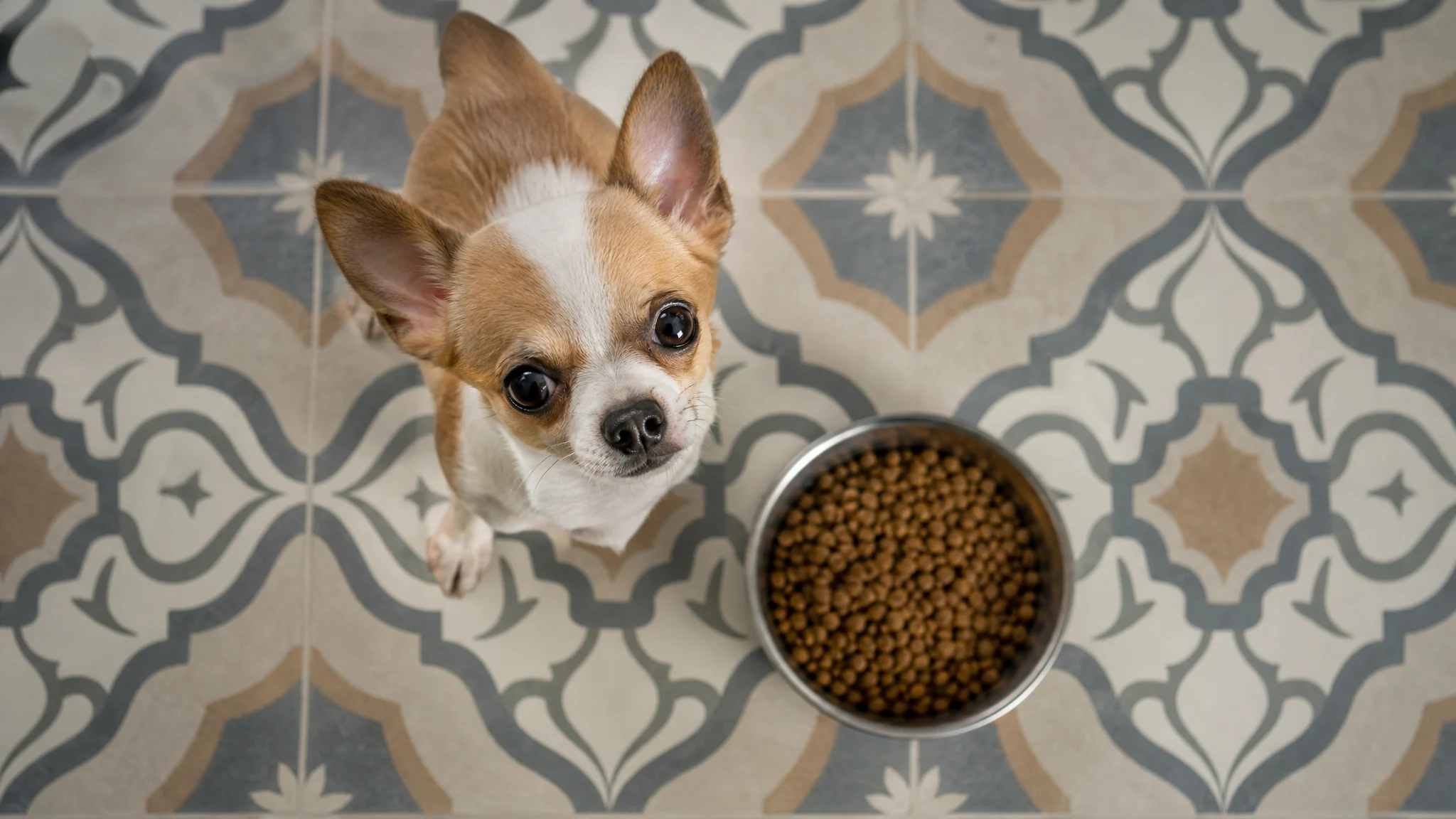
General nutrition information compiled from product labels and published sources, not veterinary advice. Your veterinarian is the right person to choose a diet for your dog, especially one with a health condition.
No label can promise a healthy gut. "Digestive support" and "gut health" are marketing phrases, not defined terms on a dog food bag. The best food for dog gut health is the one a Chihuahua eats comfortably, with steady stools and steady energy, and that your veterinarian agrees with.
This guide shows you how to compare foods by their label, how to switch foods slowly, and how to watch for signs that a diet is or is not agreeing with your dog. It is a method, not a ranking. We compared label data published by each brand. We did not run feeding trials or taste tests.
Why a Chihuahua needs its own approach
Hill's Pet Nutrition lists adult Chihuahuas at roughly 2 to 6 pounds and says they seldom exceed six pounds. Wikipedia notes that pet Chihuahuas sometimes go well past the show standard, which tops out at about 5.9 pounds. Either way, this is a toy dog with a very small daily food volume.
Two things follow from that size. A few extra kibbles are a big percentage of a day's food, and a sudden diet change is a big change for a very small digestive system. Wikipedia also lists hypoglycemia as a concern in toy-breed puppies and patellar luxation as a breed issue where weight control matters. Neither is a gut problem, but both are reasons to take vomiting, loose stools or skipped meals in a tiny dog seriously and to call your veterinarian early.
For the wider picture on breed diet factors, see our guide to Chihuahua nutrition and the diet factors that matter.
What you need before you start
- The bag, can or tray of your current food, with the ingredient list and nutritional adequacy statement visible.
- The label or brand web page of any food you are considering.
- A kitchen scale or a marked measuring cup. Cups are rough for a dog this small, so grams are better when a brand gives them.
- A notebook or phone note for a simple daily log: appetite, stool quality, vomiting, energy.
- Your dog's current weight, ideally checked on the same scale each time.
- Your veterinarian's contact details, in case the log shows something worrying.
Step 1: Start with your veterinarian, not the bag
Before changing food for gut reasons, ask your veterinarian whether the digestive signs you see have a medical cause. A food cannot treat or cure a condition, and prescription diets are something only a veterinarian prescribes. If your Chihuahua has ongoing diarrhea, repeated vomiting or a puppy that will not eat, that is a veterinary visit first and a food comparison second.
Step 2: Check the nutritional adequacy statement
Every complete dog food in the US carries a statement based on the AAFCO Dog Food Nutrient Profiles. It will say the food is complete and balanced for maintenance (adults), growth (puppies) or all life stages. Foods for growth and all life stages must also say either "including growth of large-size dogs (70 pounds or more as an adult)" or "except for growth of large-size dogs," as Whole Dog Journal explains.
A Chihuahua is far below 70 pounds, so the "except for growth of large-size dogs" wording is not a problem for this breed. What matters is that the life stage fits: a puppy food for a puppy, an adult or all-life-stages food for an adult.
Step 3: Read the ingredient list and the guaranteed analysis
Ingredients are listed by weight, so the first five tell you the most. Look at them, but do not treat any single ingredient as good or bad for digestion. Grain-free is not a gut-health feature, and a food with grains is not a problem by default. The FDA has investigated a possible link between certain diets and canine dilated cardiomyopathy. Its latest update on that page is dated December 23, 2022, and it says reports alone are not enough to establish causation. If you are weighing a grain-free diet, ask your veterinarian.
The guaranteed analysis gives minimum protein and fat and maximum fiber, on an as-fed basis. Some brands publish dry-matter averages instead, which are not the same thing. Do not compare an as-fed number with a dry-matter number directly.
Step 4: Compare real label data side by side
The table below uses figures published on each brand's own product page. Calories are per cup as the brand lists them. Hill's lists its protein, fat and fiber figures as dry-matter averages, not guaranteed minimums, so they are not directly comparable with the as-fed figures for the other products.
| Food | Life stage | First ingredients | Protein / fat / fiber | Calories per cup |
|---|---|---|---|---|
| Royal Canin Chihuahua Adult (dry) | Adult, maintenance | Corn, chicken by-product meal, wheat gluten, oat groats, brewers rice | 26% min / 14% min / 3.6% max | 323 kcal ME |
| Royal Canin Chihuahua Puppy (dry) | Puppy, growth | Chicken by-product meal, brewers rice, chicken fat, corn, wheat gluten | 28% min / 18% min / 4.0% max | 350 kcal ME |
| Hill's Science Diet Adult Small & Mini Chicken & Brown Rice (dry) | Adult, maintenance | Chicken, brown rice, whole grain wheat, whole grain corn, brewers rice | 25 / 15.3 / 1.5 (dry matter) | 357 kcal |
| Hill's Science Diet Puppy Small & Mini Chicken & Brown Rice (dry) | Puppy, growth | Chicken, whole grain oats, brown rice, chicken meal, chicken fat | 28.9 / 19.7 / 2.3 (dry matter) | 418 kcal |
| VICTOR Hi-Pro Plus Small Breed Adult (dry) | All life stages except large-size growth | Beef, chicken meal, beef meal, brown rice, whole grain millet | 30% min / 14% min / 5% max | 360 kcal |
| Freshpet Small Dog Bite Size Chicken (fresh) | All life stages except large-size growth | Chicken, chicken liver, carrots, cranberries, eggs | 16% min / 12% min / 1.5% max | 267 kcal |
Two things stand out. Calorie density varies a lot, from 267 to 418 kcal per cup in this group, so a "cup" of one food is not a cup of another. And fiber differs: VICTOR lists a 5% maximum while Hill's adult lists 1.5% on a dry-matter basis. We are not saying either is better for the gut. Fiber is one label number to discuss with your veterinarian if stools are a concern.
Other options exist. Royal Canin also makes a Chihuahua Adult loaf in sauce, and Nom Nom and JustFoodForDogs make fresh recipes that state an all-life-stages profile including large-size growth. Their pages list portions by dog weight or point to a calculator, so check the brand pages for current details.
Step 5: Pick a texture and size your dog can manage
Royal Canin describes its Chihuahua Adult kibble as customized small-sized kibble designed for the breed's pointed muzzle and tiny jaw. VICTOR calls its small-breed formula bite-sized. Hill's says its small-breed adult texture is designed for small dogs but does not state a kibble size. Freshpet describes bite-sized pieces. If a brand does not state a size, check with the brand.
A food that is hard to chew can lead to gulping, and a dog that eats poorly is hard to read. Choose something your dog can handle comfortably.
Step 6: Measure the starting amount
Feeding guides on the bag are starting points, not prescriptions. A few examples from the brands themselves:
- Royal Canin lists 1/4 cup (24 g) of its Chihuahua Adult dry food for a 2.2 lb dog on low activity.
- VICTOR lists 1/2 cup daily for a 5 lb dog on its small breed adult formula.
- Freshpet lists 1/2 to 1 cup per day for dogs of 5 to 10 pounds, in one or two meals.
Because these foods differ in calories per cup, do not carry an amount from one food to another. Weigh portions in grams when you can, and ask your veterinarian whether your dog's weight and body condition call for more or less.
Step 7: Switch foods slowly
A gradual switch is the most practical thing you control. Hill's and Nom Nom both suggest a transition of about 7 days. VICTOR suggests 7 to 10 days. A common pattern is to mix a small share of the new food into the old and increase it a little each day. Your veterinarian may suggest a slower schedule for a sensitive or very small dog.
- Days 1 to 2: mostly old food with a small amount of new food.
- Days 3 to 4: about half and half.
- Days 5 to 6: mostly new food with a little old food.
- Day 7 or later: all new food, if stools and appetite look normal.
If stools turn loose, hold at the current mix for a few days rather than pressing on. If problems continue or your dog stops eating, call your veterinarian.
Step 8: Keep a simple log for two to four weeks
Write down meals, treats, stool quality, vomiting, appetite and energy each day. Keep treats small and few, since in a dog this size a handful of treats can be a large part of daily calories. Change one thing at a time, so that if something goes wrong you know which change to look at.
Tips
- Compare foods on the same basis. As-fed and dry-matter numbers are not interchangeable.
- Use the life stage on the label. Puppy foods are richer in calories and are not recommended for adults of any weight. Hill's says its puppy formula is not recommended for adult or obese-prone dogs.
- Pick one new food at a time. Rotating several foods at once makes it hard to learn what agrees with your dog.
- Keep the old bag until the switch is done, in case you need to step back.
- Weigh your dog regularly. Weight control matters for the breed's knees, according to Wikipedia's summary of patellar luxation.
Common mistakes to avoid
- Treating "gut health" on a label as a promise. It is not a regulated claim. Judge the food by its adequacy statement, ingredients and how your dog does.
- Switching all at once. A sudden swap is a common reason for loose stools in any dog, and more so in a toy breed.
- Using cups from the wrong food. Calories per cup differ widely between brands.
- Feeding a puppy food to an adult. Pick the food that matches the life stage.
- Waiting too long with a tiny puppy. If a toy-breed puppy will not eat or seems weak, call a veterinarian promptly.
- Self-treating a medical problem with diet. Persistent digestive signs need a veterinary exam.
What results to expect
If a food suits your Chihuahua, you may see steady appetite, regular and well-formed stools, and a stable weight over a few weeks. Those are signs that the diet is agreeing with your dog. They are not proof of any health benefit, and no food can be said to prevent or treat a digestive disease. Individual dogs vary, and some do well on several different foods.
If the log shows ongoing soft stools, vomiting, weight loss or low energy, bring it to your veterinarian. A written record is far more useful than memory.
Where to check current label information
Formulas, ingredients and feeding charts change. Before you rely on anything above, check the brand's own page for the current label. The Sources below link to the pages used for this comparison.
Sources
- Hill's Pet Nutrition: Chihuahua breed page
- Wikipedia: Chihuahua (dog breed)
- FDA Center for Veterinary Medicine: investigation of diets and canine dilated cardiomyopathy
- Whole Dog Journal: nutritional adequacy statements
- Royal Canin: Chihuahua Adult dry
- Royal Canin: Chihuahua Puppy dry
- Hill's Science Diet: Adult Small & Mini
- Hill's Science Diet: Puppy Small & Mini
- VICTOR: Hi-Pro Plus Small Breed Adult
- Freshpet: Small Dog Bite Size Chicken Recipe