Best Puppy Food for Chihuahua Puppies
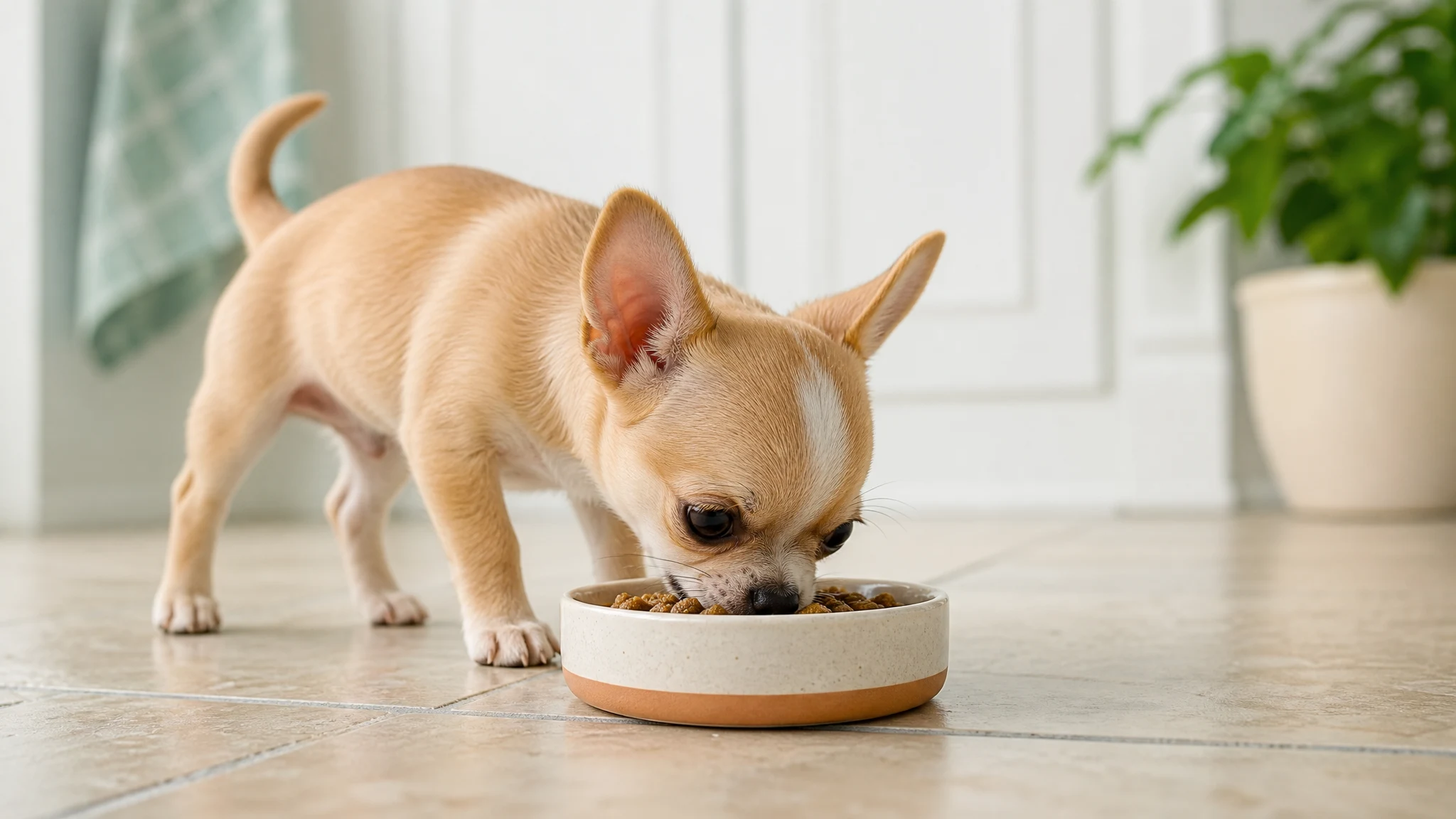
General nutrition information compiled from product labels and published sources, not veterinary advice. Your veterinarian is the right person to choose a diet for your dog, especially one with a health condition.
Choosing chihuahua puppy food is harder than it looks. A tiny dog eats very little, so every bite has to count, and the front of the bag says far less than the back.
This guide covers how to read a label for the best puppy food for Chihuahuas, which features matter, and how six foods compare on their published label data. It does not make medical promises. Your veterinarian decides what suits your individual puppy.
How we compared these foods
We compared label data: the nutritional adequacy statement, the first five ingredients, the guaranteed analysis, calories per cup and feeding guidance, all as published on each brand's own product page. We did not run feeding trials or taste tests, and we are not ranking foods by how a puppy responds to them.
Some numbers are not directly comparable. Hill's lists its protein, fat and fiber as dry matter averages, not guaranteed minimums. The other brands list guaranteed minimums and maximums on an as-fed basis. Where a detail is not published, we say so and suggest you check with the brand.
What a Chihuahua puppy needs from a food
Hill's Pet Nutrition says Chihuahuas seldom exceed six pounds, and its breed page lists a range of 2 to 6 pounds. Wikipedia notes the AKC show maximum is about 5.9 pounds, and that pet Chihuahuas sometimes exceed 9.9 pounds. Either way, this is a toy breed, far below the 70 pound threshold used on pet food labels for large-size dogs.
That small size shapes what to look for in the best food for a Chihuahua puppy:
- Small, easy-to-chew pieces. A tiny jaw and short muzzle make big kibble awkward.
- Calorie density. A puppy with a small stomach needs enough energy in a small portion.
- A label that covers growth. Not every dog food is made for puppies.
Quality indicators to look for
1. The adequacy statement covers growth
This is the first thing to check, and it is the filter we used for this guide. Look for wording that says the food meets the AAFCO Dog Food Nutrient Profiles for growth, or for all life stages. A statement that says only "maintenance" is for adult dogs.
Some statements show that a food was tested instead of just formulated. Hill's, for example, says animal feeding tests using AAFCO procedures substantiate its puppy recipe. The other foods here say they are formulated to meet the AAFCO nutrient profiles. Both are valid ways to support a complete-and-balanced claim, and neither tells you how your puppy will do on the food.
2. The large-size dog wording
Per Whole Dog Journal's explanation of nutritional adequacy statements, growth and all-life-stages labels must say either "including growth of large-size dogs (70 pounds or more as an adult)" or "except for growth of large-size dogs." A Chihuahua will never approach 70 pounds, so the "except" wording is not a concern for this breed. Do not rule a food out because of it.
3. A named animal protein early in the ingredient list
Ingredients are listed by weight before cooking, so the first five tell you the most. Chicken, beef or a named meat meal near the top is a reasonable sign. Remember that a fresh meat contains a lot of water, while a meal is concentrated, so the lists are not a perfect ranking.
4. Calories per cup and a real feeding guide
A food with a clear feeding table by age and weight is easier to portion for a puppy that weighs only a few pounds. The numbers on a bag are starting points. You adjust them based on your puppy's body condition and your veterinarian's advice.
5. Kibble size, stated plainly
Only some brands publish this. Royal Canin describes a small, customized kibble for the Chihuahua's pointed muzzle and tiny jaw. Others, such as Hill's and VICTOR, do not give a numeric size on the pages we reviewed, so check with the brand if size matters to you.
Key features to compare
The table below shows label data for the six foods whose statements cover growth. Values come from each brand's product page. Fresh foods have far more moisture, so their percentages and calories per cup look very different from dry food and should not be compared directly with dry food numbers.
| Food | Form | Label covers | Calories | Protein / fat / fiber |
|---|---|---|---|---|
| Royal Canin Chihuahua Puppy | Dry | Growth, including large-size dogs | 350 kcal ME per cup (calculated) | 28% min / 18% min / 4.0% max |
| Hill's Science Diet Puppy Small & Mini Chicken & Brown Rice | Dry | Growth, substantiated by feeding tests | 418 kcal per cup | 28.9% / 19.7% / 2.3% (dry matter averages) |
| VICTOR Hi-Pro Plus Small & Medium Breed Puppy | Dry | All life stages, except growth of large-size dogs | 383 kcal per cup | 30% min / 18% min / 5.0% max |
| Freshpet Small Dog Bite Size Chicken Recipe | Fresh | All life stages, except growth of large-size dogs | 267 kcal per cup | 16% min / 12% min / 1.5% max |
| Nom Nom Chicken Cuisine | Fresh | All life stages, including growth of large-size dogs | 244 kcal per cup (calculated) | 6.5% min / 4.5% min / 3.5% max |
| JustFoodForDogs Pantry Fresh Chicken & Rice | Fresh | All life stages, including growth of large-size dogs | About 31 kcal ME per ounce | 6.5% min / 2.5% min / 1.0% max |
Top picks by type of food
The brand pages we reviewed did not list prices, and we will not guess at them. Instead of grouping foods by cost, we group them by form. Check each brand's page for current pricing and package sizes, since a tiny puppy uses a small bag slowly and freshness matters.
Breed-specific dry food: Royal Canin Chihuahua Puppy
This is the only food on the list built around the breed. Its first five ingredients are chicken by-product meal, brewers rice, chicken fat, corn and wheat gluten. It is not grain-free. Royal Canin describes a small kibble made for a miniature puppy jaw.
Its feeding table runs by age from 2 to 9 months and by target adult weight of 2.2, 4.4 or 6.6 pounds. That is useful if you know roughly how big your puppy's parents are. Royal Canin's page says to move to its Chihuahua Adult food after 8 months. See the Royal Canin Chihuahua Puppy page.
If you prefer ingredient lists that lead with a whole meat rather than a by-product meal, compare it against the others below.
Small-breed dry food with feeding-test support: Hill's Science Diet Puppy Small & Mini
Chicken, whole grain oats, brown rice, chicken meal and chicken fat are the first five ingredients. This is the one food here whose statement relies on AAFCO feeding tests. It is also the most calorie-dense dry food in the table at 418 kcal per cup, so portions will be small. The page does not state kibble size, and it says the food is not recommended for adult dogs or dogs prone to obesity.
Hill's recommends a 7 day transition and adjusting amounts to keep an optimal weight. See the Hill's product page.
Higher-protein dry food: VICTOR Hi-Pro Plus Small & Medium Breed Puppy
VICTOR lists 30% minimum protein and 18% minimum fat, with beef, chicken, beef meal, chicken meal and whole grain sorghum as the first five ingredients. It is not grain-free. The label is an all-life-stages statement, so it covers growth for a small breed. The page says only "appropriate kibble size" for small and medium breeds, so ask the brand about piece size if you have a very small puppy.
Its example feeding is 1 cup per day for a 6 pound puppy aged 3 to 4 months, with a 7 to 10 day transition. Compare that with the Chihuahua weights above and start with the lower end of the guide. See the VICTOR product page.
Fresh options
Three fresh foods have labels that cover growth. All are cooked, refrigerated products, and their numbers are not comparable to dry food because of moisture.
- Freshpet Small Dog Bite Size Chicken Recipe lists chicken, chicken liver, carrots, cranberries and eggs first. It is described as grain-free, in bite-sized pieces for small dogs. The feeding table on the page starts at 5 to 10 pounds (1/2 to 1 cup per day), which is above the size of many young Chihuahuas, so confirm amounts with the brand and your veterinarian. See the Freshpet page.
- Nom Nom Chicken Cuisine is a general recipe, not a small-breed one. It lists chicken, sweet potatoes, squash, spinach and dicalcium phosphate first. The page's example is 1 cup per day for a 10 pound dog on a fully Nom Nom diet, so it does not give Chihuahua-puppy-sized amounts. See the Nom Nom page.
- JustFoodForDogs Pantry Fresh Chicken & Rice lists chicken breast, chicken thighs, chicken liver, long-grain white rice and kale first. The page gives no fixed amount and points to a feeding calculator based on calorie needs. See the JustFoodForDogs page.
Ask each brand how its product is meant to be portioned for a puppy under 5 pounds before you commit.
Foods we left out, and why
Royal Canin's Chihuahua Adult dry and loaf-in-sauce foods, and Hill's Adult Small & Mini, are labeled for maintenance only. They are not puppy foods, so they are not in the comparison. VICTOR's adult small breed formula is also left out because the puppy formula is the one designed for this stage.
Red flags to avoid
- A maintenance-only statement on a puppy. If the label says only adult maintenance, it is the wrong food for growth.
- No adequacy statement at all. Treats, toppers and some homemade-style products may not be complete diets.
- Medical promises on the package. No food prevents or cures conditions such as allergies, joint problems or heart disease. Be skeptical of any bag that suggests otherwise.
- Big kibble. If your puppy struggles to chew or swallow it, ask the brand about size or choose a different formula.
- Vague ingredient language. "Meat" or "animal" without a named source tells you little.
- Feeding guides that start well above your puppy's weight. Several of the fresh foods above do. Do not simply scale down without asking.
- Using a prescription diet without being told to. Those are for a veterinarian to prescribe for a specific dog.
A note on grain-free and DCM
The FDA Center for Veterinary Medicine investigated a possible link between certain diets and canine dilated cardiomyopathy. Its latest update on that page is dated December 23, 2022. The FDA says reports alone are not enough to establish causation, and it does not plan further public updates until there is meaningful new scientific information. Check the FDA page for anything newer, and talk with your veterinarian before choosing a grain-free diet.
Feeding basics for a Chihuahua puppy
Several small meals a day
Very small puppies are generally fed several small meals a day instead of one or two large ones. Wikipedia notes that hypoglycemia, or low blood sugar, is a concern in toy-breed puppies, which is one reason a regular feeding schedule matters. Ask your veterinarian how many meals and what amounts fit your puppy, and what signs of low blood sugar to watch for. Do not skip meals or let a puppy go long gaps without eating.
Treat the label amount as a starting point
Every guide here is a starting figure. Weigh your puppy regularly, watch body condition, and adjust with your veterinarian. Wikipedia also lists patellar luxation, a kneecap problem, as a Chihuahua concern where weight control is relevant. That is another reason to avoid overfeeding a small dog.
Switch foods gradually
Hill's and VICTOR both recommend moving to a new food over about 7 days (VICTOR says 7 to 10). Mix a little of the new food in and increase it slowly.
When to move to adult food
Royal Canin's page says to move to its Chihuahua Adult food after 8 months. Hill's describes its puppy food for dogs up to 1 year. We did not find a single breed-wide age for when a Chihuahua counts as an adult, so ask your veterinarian or the breeder, and check the brand's page for its own guidance. Growth-stage concerns about large-breed puppies do not apply to this toy breed, per Hill's breed page.
Where to buy
Brand websites list the exact product and current label, and most brands also state where their foods are sold. We do not link to any stores here, and we cannot tell you where a particular product is in stock or at what price.
Whatever you choose, check these basics when the bag arrives:
- The name matches the product you meant to buy, including the life stage (puppy, not adult).
- The adequacy statement and ingredient list match the brand's page. Formulas change over time.
- The best-by date is well ahead, and the package is sealed and undamaged.
- For fresh foods, you have refrigerator space and know how the brand delivers or stocks it.
For a tiny puppy, a smaller package often makes sense because open dry food loses freshness. Check the storage guidance on the brand's page.
The bottom line
For the best puppy food for Chihuahuas, start with the adequacy statement, then compare ingredients, calories, kibble size and the feeding guide. Among the foods here, Royal Canin Chihuahua Puppy is the one made specifically for the breed, Hill's Puppy Small & Mini is the one supported by AAFCO feeding tests, and VICTOR's puppy formula is the highest in listed protein. The fresh options need extra care with portions for puppies this small.
Your veterinarian can match any of these to your puppy's weight, health and schedule. Bring the label with you.
Sources
- Royal Canin US: Chihuahua Puppy Dry Dog Food
- Hill's Pet Nutrition: Science Diet Puppy Small & Mini Chicken & Brown Rice Recipe
- Hill's Pet Nutrition: Chihuahua breed page
- VICTOR: Hi-Pro Plus Small & Medium Breed Puppy
- Freshpet: Small Dog Bite Size Chicken Recipe
- Nom Nom: Chicken Cuisine
- JustFoodForDogs: Pantry Fresh Chicken & Rice
- FDA Center for Veterinary Medicine: Investigation into diets and canine dilated cardiomyopathy
- Whole Dog Journal: In the Fine Print, Nutritional Adequacy Statements
- Wikipedia: Chihuahua (dog breed)